
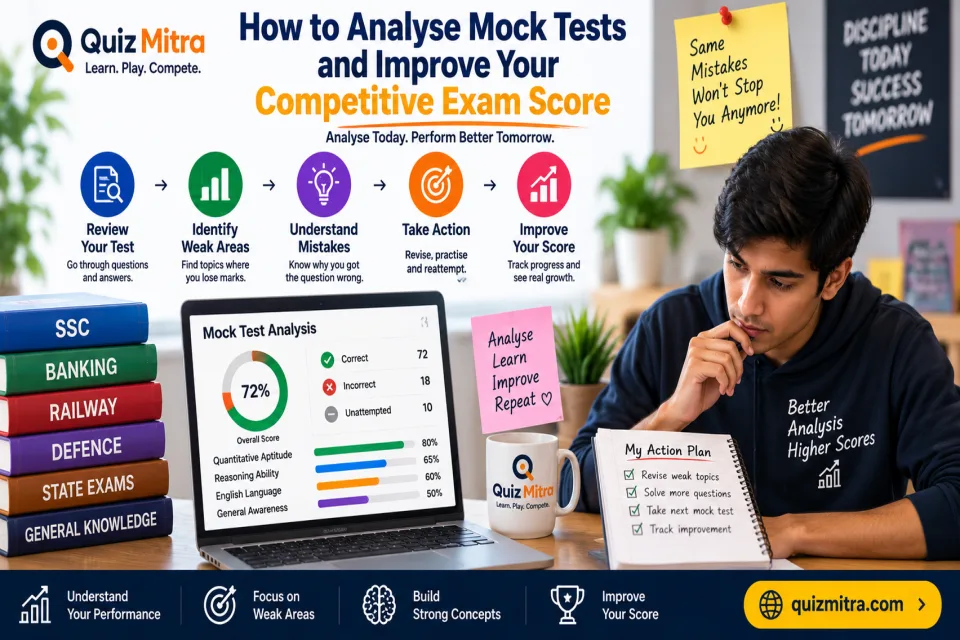
Taking mock tests is an important part of competitive exam preparation, but simply completing a test and checking your score is not enough.
The real improvement begins when you analyse your performance and understand why you got questions wrong.
A good mock-test routine follows a simple cycle: Take the Test → Analyse → Fix Mistakes → Practise → Take the Next Test
This approach can help you improve your accuracy, time management, question selection and overall exam strategy.
A good mock-test routine follows a simple cycle: Take the Test → Analyse → Fix Mistakes → Practise → Take the Next Test
This approach can help you improve your accuracy, time management, question selection and overall exam strategy.
Table of Contents
Why Mock Test Analysis Matters
A mock test gives you an idea of how well you can perform under exam-like conditions.
However, your final score only tells you the result. It doesn't explain why you lost marks.
For example, two students may score 65 marks, but their problems could be completely different. One student may have weak concepts, while another may know the concepts but lose marks because of poor time management.
That's why analysing your mock test is just as important as taking it.
If you regularly review your performance, each mock test can become a learning opportunity rather than simply another score.
However, your final score only tells you the result. It doesn't explain why you lost marks.
For example, two students may score 65 marks, but their problems could be completely different. One student may have weak concepts, while another may know the concepts but lose marks because of poor time management.
That's why analysing your mock test is just as important as taking it.
If you regularly review your performance, each mock test can become a learning opportunity rather than simply another score.
A mock test shows your current level. Analysing it shows you how to improve.
Don't Focus Only on Your Score
It is natural to check your score immediately after completing a mock test.
But don't stop there.
Along with your score, look at your:
These details can tell you much more about your preparation than the final score alone.
For example, a lower score with high accuracy may indicate that you need to improve your speed, while a high attempt rate with many incorrect answers may indicate an accuracy problem.
But don't stop there.
Along with your score, look at your:
- Accuracy percentage
- Number of questions attempted
- Number of incorrect answers
- Questions left unanswered
- Average time spent on questions
- Performance in individual sections
These details can tell you much more about your preparation than the final score alone.
For example, a lower score with high accuracy may indicate that you need to improve your speed, while a high attempt rate with many incorrect answers may indicate an accuracy problem.
Identify Your Mistake Types
After every mock test, review the questions you answered incorrectly.
Try to identify the reason behind each mistake. Most mistakes usually fall into a few common categories:
Once you know the type of mistake, you can choose a better way to fix it.
Try to identify the reason behind each mistake. Most mistakes usually fall into a few common categories:
- Concept mistake: You didn't understand the underlying concept.
- Memory mistake: You studied the topic but couldn't recall the information.
- Silly mistake: You knew the answer but made an avoidable error.
- Calculation mistake: You made an error while solving the problem.
- Time-management mistake: You spent too much time on another question.
- Question-reading mistake: You misunderstood what the question was asking.
Once you know the type of mistake, you can choose a better way to fix it.
Find Your Weak Topics
Don't treat every incorrect answer as an isolated mistake.
Look for patterns.
Suppose you repeatedly get questions wrong from topics such as Indian Polity, Geography, Percentage, Profit and Loss or Reasoning.
That pattern tells you where your preparation needs more attention.
Make a list of your weak topics and give them additional revision and practice time.
You can use Quiz Mitra quizzes to practise individual topics and test whether your accuracy improves after revision.
Look for patterns.
Suppose you repeatedly get questions wrong from topics such as Indian Polity, Geography, Percentage, Profit and Loss or Reasoning.
That pattern tells you where your preparation needs more attention.
Make a list of your weak topics and give them additional revision and practice time.
You can use Quiz Mitra quizzes to practise individual topics and test whether your accuracy improves after revision.
Find Time-Wasting Questions
A question can be a problem even when you answer it correctly.
If you spend three or four minutes solving one difficult question, you may lose the opportunity to answer several easier questions.
During your mock-test analysis, identify questions that consumed too much time.
Ask yourself:
Practising previous year questions can help you become more familiar with common question patterns and improve your decision-making speed.
If you spend three or four minutes solving one difficult question, you may lose the opportunity to answer several easier questions.
During your mock-test analysis, identify questions that consumed too much time.
Ask yourself:
- Could I have solved this question faster?
- Should I have skipped it initially?
- Did I choose the wrong method?
- Was the question actually worth the time I spent on it?
Practising previous year questions can help you become more familiar with common question patterns and improve your decision-making speed.
Create a Mistake Notebook
One simple technique is to maintain a dedicated mistake notebook.
Whenever you make an important mistake in a mock test, record:
Review this notebook regularly.
Over time, you'll notice that some mistakes occur repeatedly. Those repeated mistakes should become a priority in your revision plan.
Whenever you make an important mistake in a mock test, record:
- The question or topic
- Your incorrect approach
- The correct concept or method
- Why you made the mistake
- A short reminder for future tests
Review this notebook regularly.
Over time, you'll notice that some mistakes occur repeatedly. Those repeated mistakes should become a priority in your revision plan.
Practise Previous Year Questions
Mock tests are useful, but previous year questions are equally important because they show you the
types of questions that have actually appeared in the examination.
After identifying a weak topic from a mock test, practise related previous year questions instead of immediately taking another full-length test.
For example, if your mock-test analysis shows that your Indian History performance is weak, revise the relevant topics and then practise history questions.
This creates a more focused preparation cycle: Identify → Revise → Practise → Test Again.
After identifying a weak topic from a mock test, practise related previous year questions instead of immediately taking another full-length test.
For example, if your mock-test analysis shows that your Indian History performance is weak, revise the relevant topics and then practise history questions.
This creates a more focused preparation cycle: Identify → Revise → Practise → Test Again.
Improve Your Strategy for the Next Mock
Your next mock test should not be exactly the same as the previous one.
Take one or two specific lessons from your analysis and apply them to the next test.
For example:
Don't try to change everything at once. Focus on one or two improvements and measure the result in your next mock.
Take one or two specific lessons from your analysis and apply them to the next test.
For example:
- Attempt easy questions first.
- Reduce the time spent on difficult questions.
- Improve accuracy before increasing attempts.
- Spend more time on your weakest section.
- Leave a few minutes for final review.
Don't try to change everything at once. Focus on one or two improvements and measure the result in your next mock.
Follow the Test → Analyse → Improve Cycle
The most effective way to use mock tests is to create a continuous improvement cycle.
Step 1 — Take the Test: Attempt the mock under realistic exam conditions.
Step 2 — Check Your Performance: Review your score, accuracy, attempts and time.
Step 3 — Analyse Mistakes: Identify concept gaps, memory errors, silly mistakes and time-management problems.
Step 4 — Fix Weak Areas: Revise the relevant concepts and practise more questions.
Step 5 — Take Another Test: Apply your new strategy and compare your performance with the previous mock.
Step 1 — Take the Test: Attempt the mock under realistic exam conditions.
Step 2 — Check Your Performance: Review your score, accuracy, attempts and time.
Step 3 — Analyse Mistakes: Identify concept gaps, memory errors, silly mistakes and time-management problems.
Step 4 — Fix Weak Areas: Revise the relevant concepts and practise more questions.
Step 5 — Take Another Test: Apply your new strategy and compare your performance with the previous mock.
Combine Mock Tests With Daily Quiz Practice
Full-length mock tests are important, but you don't need to take them every day.
On regular study days, use short online quizzes to practise specific topics and maintain consistency.
For Current Affairs preparation, a daily current affairs quiz can help you regularly test your knowledge.
A balanced routine could look like this:
On regular study days, use short online quizzes to practise specific topics and maintain consistency.
For Current Affairs preparation, a daily current affairs quiz can help you regularly test your knowledge.
A balanced routine could look like this:
- Daily: Short quizzes and topic practice
- Weekly: Full-length mock test
- After every mock: Detailed analysis
- Before the next mock: Revise identified weak areas
Turn Every Mock Test Into an Opportunity to Improve
A mock test should never be treated as just another number on your preparation record.
Your score tells you where you are today, but your mistakes tell you what you need to work on next.
Analyse your mistakes, identify weak topics, improve your time management, practise targeted questions and then take another mock.
The goal is simple: Test → Analyse → Fix → Practise → Improve.
Use Quiz Mitra mock tests for exam-style practice and combine them with daily quizzes and previous year questions to build a consistent preparation routine.
Quiz Mitra — Learn. Play. Compete.
Your score tells you where you are today, but your mistakes tell you what you need to work on next.
Analyse your mistakes, identify weak topics, improve your time management, practise targeted questions and then take another mock.
The goal is simple: Test → Analyse → Fix → Practise → Improve.
Use Quiz Mitra mock tests for exam-style practice and combine them with daily quizzes and previous year questions to build a consistent preparation routine.
Quiz Mitra — Learn. Play. Compete.