
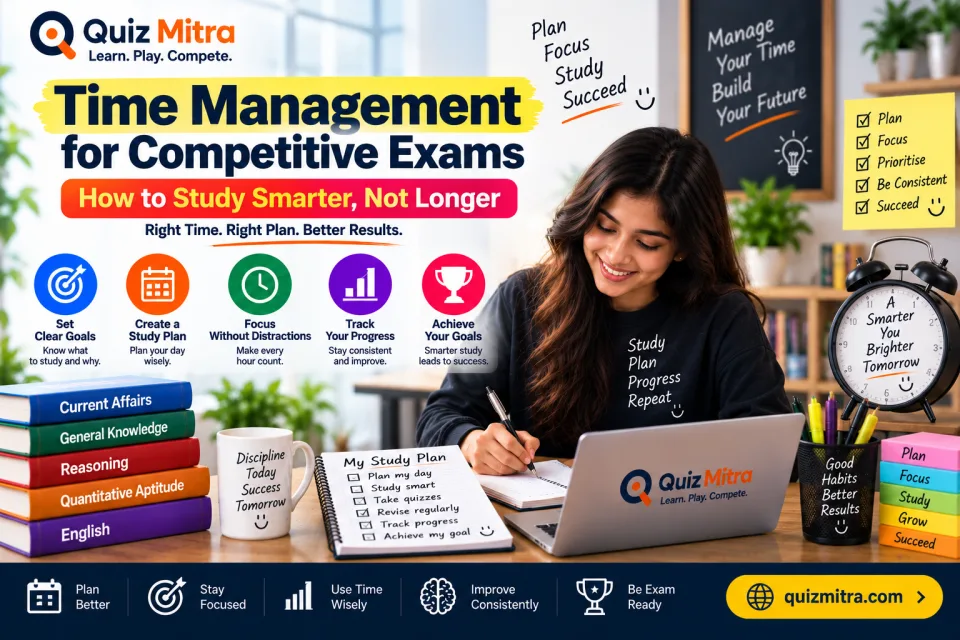
Here's an uncomfortable truth: most aspirants who struggle to clear competitive exams aren't necessarily short on knowledge — they're often missing a proper study system.
Studying for long hours does not automatically guarantee better results. What matters is how effectively you use your available time, how regularly you test yourself, and whether you learn from your mistakes.
A simple combination of weekly planning, active recall, mock tests, time management and consistent revision can help you get much more value from the same number of study hours.
Studying for long hours does not automatically guarantee better results. What matters is how effectively you use your available time, how regularly you test yourself, and whether you learn from your mistakes.
A simple combination of weekly planning, active recall, mock tests, time management and consistent revision can help you get much more value from the same number of study hours.
Table of Contents
Plan the Week, Not Just the Day
A daily to-do list can easily fall apart when something unexpected happens. You may plan to complete three chapters on Monday, but if you miss one task, the entire schedule can feel difficult to manage.
A weekly study plan gives you more flexibility. Instead of worrying about completing everything on a particular day, decide which subjects and topics you want to cover during the entire week.
For example, you could divide your week between:
Keep at least one flexible study slot for revision or catching up on topics that you couldn't complete earlier.
You can also use previous year questions to understand which topics are important for your target examination.
A weekly study plan gives you more flexibility. Instead of worrying about completing everything on a particular day, decide which subjects and topics you want to cover during the entire week.
For example, you could divide your week between:
- General Knowledge
- Current Affairs
- Quantitative Aptitude
- Reasoning
- English
- Previous Year Questions
- Mock Tests and Revision
Keep at least one flexible study slot for revision or catching up on topics that you couldn't complete earlier.
You can also use previous year questions to understand which topics are important for your target examination.
Studying for eight hours means nothing if you can't recall it in the exam hall.
Replace Re-reading With Active Recall
Re-reading the same notes again and again can feel productive, but simply looking at information doesn't always mean you can remember it when you need it.
Active recall is a more practical approach. Instead of repeatedly reading a chapter, close your book or notes and try to answer questions from memory.
One easy way to practise active recall is by taking a quiz after completing a topic.
For example, after studying Indian History, attempt a short History quiz without looking at your notes. The questions you answer incorrectly can show you exactly which areas require another revision.
This approach turns passive reading into active learning and helps you identify knowledge gaps much faster.
Active recall is a more practical approach. Instead of repeatedly reading a chapter, close your book or notes and try to answer questions from memory.
One easy way to practise active recall is by taking a quiz after completing a topic.
For example, after studying Indian History, attempt a short History quiz without looking at your notes. The questions you answer incorrectly can show you exactly which areas require another revision.
This approach turns passive reading into active learning and helps you identify knowledge gaps much faster.
Simulate the Real Exam Timing
Knowing the syllabus isn't enough. You also need to know how to manage your time during the actual examination.
If you normally solve questions without a timer, it can be difficult to understand how quickly you need to work during the real exam.
Regularly attempt full-length mock tests using the actual examination time limit.
During these tests, practise deciding:
This helps you develop exam speed and prevents you from spending too much time on a single difficult question.
If you normally solve questions without a timer, it can be difficult to understand how quickly you need to work during the real exam.
Regularly attempt full-length mock tests using the actual examination time limit.
During these tests, practise deciding:
- Which questions should be solved immediately?
- Which questions should be skipped?
- When should you return to a difficult question?
- How much time should be reserved for the final review?
This helps you develop exam speed and prevents you from spending too much time on a single difficult question.
Track Your Progress
Motivation can change from day to day, but a good study system helps you remain consistent.
Instead of judging your preparation only by the number of hours studied, track useful indicators such as:
A leaderboard can also add a friendly competitive element to your preparation, especially when you're practising with friends or other learners.
The goal isn't simply to compete with someone else. Use your previous scores as a benchmark and focus on improving your own performance.
Instead of judging your preparation only by the number of hours studied, track useful indicators such as:
- Quiz accuracy
- Mock test scores
- Number of questions attempted
- Topics completed
- Repeated mistakes
- Average time per question
A leaderboard can also add a friendly competitive element to your preparation, especially when you're practising with friends or other learners.
The goal isn't simply to compete with someone else. Use your previous scores as a benchmark and focus on improving your own performance.
Build a Daily Practice Habit
Consistency is often more important than occasional long study sessions.
Even on busy days, try to spend a few minutes testing yourself. A short daily current affairs quiz can help you revise important events and maintain a regular practice habit.
You can also use Quiz Mitra quizzes for topic-wise practice whenever you have a few free minutes.
A simple daily routine could look like this:
The exact schedule can change according to your exam and available study time. The important thing is to create a routine that you can actually follow.
Even on busy days, try to spend a few minutes testing yourself. A short daily current affairs quiz can help you revise important events and maintain a regular practice habit.
You can also use Quiz Mitra quizzes for topic-wise practice whenever you have a few free minutes.
A simple daily routine could look like this:
- 10 minutes: Current Affairs or GK quiz
- 20–30 minutes: Topic revision
- 20 minutes: Practice questions
- Weekly: Full-length mock test
- After every mock: Analyse mistakes
The exact schedule can change according to your exam and available study time. The important thing is to create a routine that you can actually follow.
Final Time-Management Tips for Competitive Exams
Effective time management isn't about studying every minute of the day. It's about making sure the time you spend studying produces meaningful progress.
Keep these simple habits in your preparation:
Keep these simple habits in your preparation:
- Plan your study week in advance.
- Set realistic daily targets.
- Use active recall instead of repeatedly re-reading notes.
- Practise with timed questions.
- Take regular full-length mock tests.
- Analyse your mistakes after every mock.
- Track your scores and accuracy.
- Keep a regular Current Affairs practice routine.
- Leave some time for revision and unexpected delays.
- Focus on consistency rather than studying for extremely long hours.
Build a Study System That Works for You
Good exam preparation isn't simply about how many hours you study. It's about what you do with those hours.
Plan your week, test yourself regularly, practise under realistic time limits, analyse your mistakes, and track your progress.
Remember the simple cycle: Plan → Learn → Practise → Test → Analyse → Improve.
Use Quiz Mitra for regular quiz practice, daily revision and knowledge testing, and make every study session a step towards better exam performance.
Plan your week, test yourself regularly, practise under realistic time limits, analyse your mistakes, and track your progress.
Remember the simple cycle: Plan → Learn → Practise → Test → Analyse → Improve.
Use Quiz Mitra for regular quiz practice, daily revision and knowledge testing, and make every study session a step towards better exam performance.