
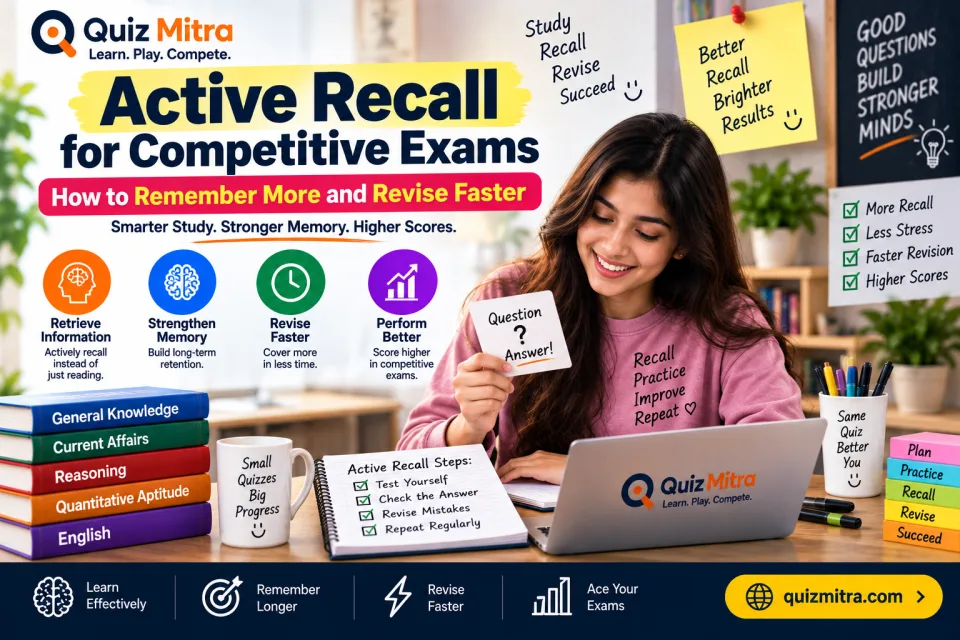
Reading the same notes again and again can feel productive, but simply reading does not always mean
that you will remember the information when you need it in an exam.
This is where active recall can make a difference. Instead of repeatedly reading the same material, you actively try to remember the information without looking at your notes.
For competitive exam preparation, you can combine active recall with quizzes, self-testing, revision and mock tests to make your study sessions more effective.
This is where active recall can make a difference. Instead of repeatedly reading the same material, you actively try to remember the information without looking at your notes.
For competitive exam preparation, you can combine active recall with quizzes, self-testing, revision and mock tests to make your study sessions more effective.
Table of Contents
- What Is Active Recall?
- Why Active Recall Is Useful for Competitive Exams
- Reading vs Testing Yourself
- How to Use Quizzes for Active Recall
- Create Questions From Your Notes
- Combine Active Recall With Spaced Revision
- Use Active Recall for GK and Current Affairs
- Combine Active Recall With Mock Tests
- A Simple Daily Active Recall Routine
- Final Tips for Better Retention
What Is Active Recall?
Active recall is a study technique where you try to retrieve information from your memory
instead of simply reading it again.
For example, imagine you have studied an important topic in Indian History. Instead of opening your notes and reading the same paragraph again, close the book and ask yourself:
What were the main events? Who was involved? What happened and why?
Try to answer these questions from memory. After that, check your notes and identify anything you forgot.
This simple process turns passive reading into active learning.
For example, imagine you have studied an important topic in Indian History. Instead of opening your notes and reading the same paragraph again, close the book and ask yourself:
What were the main events? Who was involved? What happened and why?
Try to answer these questions from memory. After that, check your notes and identify anything you forgot.
This simple process turns passive reading into active learning.
Don't just read the answer. Close the book and try to remember it.
Why Active Recall Is Useful for Competitive Exams
Competitive exams require you to retrieve information quickly and accurately.
You may have read a topic several times, but during the exam there are no notes in front of you. You have to recall the information on your own.
Active recall gives you an opportunity to practise this exact skill.
It can help you:
The goal isn't to eliminate reading completely. Instead, use reading to learn a topic and active recall to check whether you can remember it.
You may have read a topic several times, but during the exam there are no notes in front of you. You have to recall the information on your own.
Active recall gives you an opportunity to practise this exact skill.
It can help you:
- Check what you actually remember
- Identify knowledge gaps
- Strengthen revision
- Improve recall speed
- Make study sessions more interactive
- Reduce dependence on repeated reading
The goal isn't to eliminate reading completely. Instead, use reading to learn a topic and active recall to check whether you can remember it.
Reading vs Testing Yourself
Re-reading your notes can create a feeling of familiarity. You may recognise the information
when you see it, but recognition is different from recalling it without help.
Consider these two approaches.
Method 1 — Passive Reading
Read a chapter → Read it again → Highlight important points → Move to the next chapter.
Method 2 — Active Recall
Read the topic → Close your notes → Ask yourself questions → Answer from memory → Check the answer → Revise your mistakes.
The second approach gives you immediate feedback about what you know and what you need to revise.
Consider these two approaches.
Method 1 — Passive Reading
Read a chapter → Read it again → Highlight important points → Move to the next chapter.
Method 2 — Active Recall
Read the topic → Close your notes → Ask yourself questions → Answer from memory → Check the answer → Revise your mistakes.
The second approach gives you immediate feedback about what you know and what you need to revise.
How to Use Quizzes for Active Recall
Quizzes are a simple way to turn active recall into a regular study habit.
After studying a topic, don't immediately open your notes again. Instead, test yourself with questions.
You can use Quiz Mitra quizzes to practise different subjects and check how much you remember.
When you answer a question incorrectly, don't simply look at the correct option and continue. Spend a moment understanding why your answer was wrong.
A useful cycle is: Study → Quiz → Check Mistakes → Revise → Quiz Again
This makes quizzes part of your learning process rather than just a final test.
After studying a topic, don't immediately open your notes again. Instead, test yourself with questions.
You can use Quiz Mitra quizzes to practise different subjects and check how much you remember.
When you answer a question incorrectly, don't simply look at the correct option and continue. Spend a moment understanding why your answer was wrong.
A useful cycle is: Study → Quiz → Check Mistakes → Revise → Quiz Again
This makes quizzes part of your learning process rather than just a final test.
Create Questions From Your Notes
You don't always need a ready-made quiz to practise active recall.
You can create questions from your own study material.
For example, after studying Indian Polity, create questions such as:
Close your notes and try to answer each question.
This technique can also be used for Geography, Science, History, Banking, Railway, SSC and other competitive-exam subjects.
You can create questions from your own study material.
For example, after studying Indian Polity, create questions such as:
- What is the role of the President of India?
- What are the Fundamental Rights?
- How is the Prime Minister appointed?
- What is the difference between Lok Sabha and Rajya Sabha?
Close your notes and try to answer each question.
This technique can also be used for Geography, Science, History, Banking, Railway, SSC and other competitive-exam subjects.
Combine Active Recall With Spaced Revision
One study session is rarely enough to remember everything for a long period.
Instead of trying to revise an entire topic repeatedly in one day, revisit important information at different intervals.
For example:
You can adjust the schedule according to your exam date and the difficulty of the topic.
The important idea is to keep retrieving information instead of waiting until the last moment for one large revision session.
Instead of trying to revise an entire topic repeatedly in one day, revisit important information at different intervals.
For example:
- Day 1: Learn the topic and test yourself.
- Day 2: Quickly recall the main points.
- Day 4: Take another short quiz.
- Day 7: Test yourself again.
- Later: Include the topic in a mock test.
You can adjust the schedule according to your exam date and the difficulty of the topic.
The important idea is to keep retrieving information instead of waiting until the last moment for one large revision session.
Use Active Recall for GK and Current Affairs
General Knowledge and Current Affairs contain a large amount of information, making regular
recall particularly useful.
Instead of reading Current Affairs articles repeatedly, read the important information once and then test yourself with questions.
A daily current affairs quiz can help you turn daily news revision into active practice.
You can also use GK quizzes to regularly test facts related to History, Geography, Science, Polity and other subjects.
If you get a question wrong, add that topic to your revision list and test yourself again later.
Instead of reading Current Affairs articles repeatedly, read the important information once and then test yourself with questions.
A daily current affairs quiz can help you turn daily news revision into active practice.
You can also use GK quizzes to regularly test facts related to History, Geography, Science, Polity and other subjects.
If you get a question wrong, add that topic to your revision list and test yourself again later.
Combine Active Recall With Mock Tests
Short quizzes are useful for topic-level recall, while full-length mock tests help you practise
recalling information under realistic exam conditions.
Regularly attempt mock tests after completing your revision.
Don't focus only on the final score. Analyse the questions you couldn't remember and identify the topics that need additional revision.
You can also use previous year questions to test whether you can recall information in the types of questions that appear in your target exam.
A strong preparation cycle can therefore look like: Learn → Recall → Practise → Mock Test → Analyse → Revise
Regularly attempt mock tests after completing your revision.
Don't focus only on the final score. Analyse the questions you couldn't remember and identify the topics that need additional revision.
You can also use previous year questions to test whether you can recall information in the types of questions that appear in your target exam.
A strong preparation cycle can therefore look like: Learn → Recall → Practise → Mock Test → Analyse → Revise
A Simple Daily Active Recall Routine
You don't need to completely change your existing study schedule to start using active recall.
Try adding short recall sessions throughout the day.
For example:
On busy days, even a short daily quiz can help you maintain the habit.
Try adding short recall sessions throughout the day.
For example:
- 20–30 minutes: Study a new topic.
- 5 minutes: Close your notes and recall the main points.
- 10 minutes: Take a short quiz.
- 5 minutes: Review incorrect answers.
- Later: Recall the same topic without looking at your notes.
On busy days, even a short daily quiz can help you maintain the habit.
Final Tips for Better Retention
Active recall becomes more useful when you use it consistently.
Keep these simple points in mind:
Keep these simple points in mind:
- Don't rely only on repeated reading.
- Close your notes and try to remember information.
- Use questions to test yourself regularly.
- Review incorrect answers carefully.
- Revisit difficult topics at different intervals.
- Use daily quizzes for short practice sessions.
- Combine topic quizzes with mock tests.
- Use previous year questions to test exam-specific recall.
- Track the topics you repeatedly forget.
Make Active Recall Part of Your Exam Preparation
Remembering information for an exam isn't only about how many times you read it.
It's also about how often you practise retrieving it from memory.
Start with one topic. Study it, close your notes, test yourself and review your mistakes. Repeat the process regularly and gradually make it part of your daily preparation routine.
The simple formula is: Learn → Recall → Practise → Revise → Test Again.
Use Quiz Mitra quizzes for regular self-testing, practise daily Current Affairs, attempt mock tests and use previous year questions to strengthen your preparation.
The goal isn't to study everything repeatedly. It's to make what you study easier to recall when you actually need it.
Quiz Mitra — Learn. Play. Compete.
Start with one topic. Study it, close your notes, test yourself and review your mistakes. Repeat the process regularly and gradually make it part of your daily preparation routine.
The simple formula is: Learn → Recall → Practise → Revise → Test Again.
Use Quiz Mitra quizzes for regular self-testing, practise daily Current Affairs, attempt mock tests and use previous year questions to strengthen your preparation.
The goal isn't to study everything repeatedly. It's to make what you study easier to recall when you actually need it.
Quiz Mitra — Learn. Play. Compete.