SEO has changed a lot in the last few years. The basic idea is still the same — create something useful and make it easy for search engines to understand — but the amount of research involved has grown significantly.
A single article can now involve keyword research, competitor analysis, search-intent research, content planning, internal linking, technical checks, updating old pages and measuring what happened after publication.
That is where AI can be genuinely useful.
The right SEO tool can remove hours of repetitive work. It can help you find better keyword ideas, understand competing pages, spot content gaps and catch technical problems. But it is important to understand what these tools actually do.
No AI SEO tool can guarantee a Google ranking. What it can do is give you better information and a faster workflow.
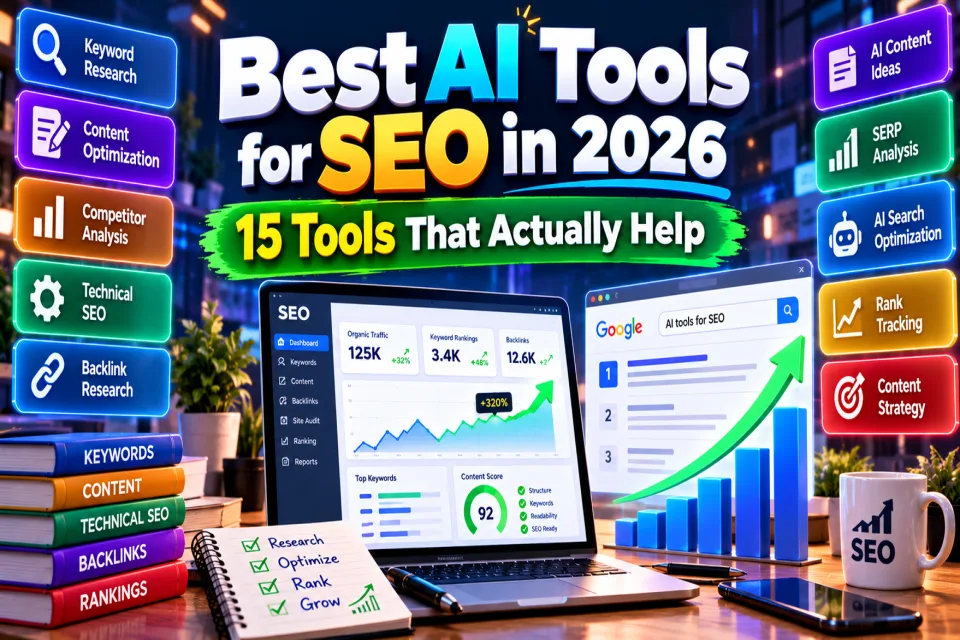
In this guide, we have picked 15 AI-powered SEO tools worth knowing in 2026 and explained where each one fits best.
Table of Contents
- What Makes an AI SEO Tool Useful?
- Best AI Tools for SEO in 2026
- Surfer SEO
- Semrush
- Ahrefs
- Frase
- MarketMuse
- Clearscope
- Mangools
- KeywordTool.io
- Keyword Chef
- Sitebulb
- Detailed SEO Extension
- Adobe LLM Optimizer
- WhereGoes
- Fathom Analytics
- Which AI SEO Tool Should You Choose?
- How to Use AI Without Making Your Content Sound Like AI
- What Actually Helps a Blog Rank on Google?
- Frequently Asked Questions
- Final Thoughts
What Makes an AI SEO Tool Useful?
There is a big difference between an AI tool that simply generates text and an SEO tool that helps you make better decisions.
For SEO, I would look at five things before paying for any platform:
- Does it provide useful search data?
- Does it save meaningful manual work?
- Does it help you understand search intent?
- Can you turn its data into an actual SEO action?
- Does it fit your website size and budget?
A dashboard full of numbers is not automatically useful. The best tools are the ones that help answer a simple question: "What should I do next?"
Best AI Tools for SEO in 2026
Instead of calling one platform the winner for everyone, it makes more sense to look at what each tool is actually good at.
| Tool | Best For | Ideal User |
|---|---|---|
| Surfer SEO | Content optimization | Bloggers & content teams |
| Semrush | All-round SEO research | SEO professionals & businesses |
| Ahrefs | Backlinks & competitor research | Experienced SEOs |
| Frase | Content research & briefs | Bloggers & writers |
| MarketMuse | Content strategy | Large content websites |
| Clearscope | Content optimization | Editorial teams |
| Mangools | Keyword research | Beginners & bloggers |
| KeywordTool.io | Keyword discovery | Content creators |
| Keyword Chef | Long-tail keywords | Niche bloggers |
| Sitebulb | Technical SEO | SEO professionals |
| Detailed SEO Extension | Quick on-page checks | Bloggers & SEOs |
| Adobe LLM Optimizer | AI search visibility | Modern SEO teams |
| WhereGoes | Redirect analysis | Technical SEOs |
| Fathom Analytics | Website analytics | Privacy-focused sites |
1. Surfer SEO — Best for Content Optimization
If your main job is publishing articles, Surfer SEO is one of the more practical tools to consider.
Its strength is content optimization. You give it a topic or target query and it can help you understand what competing pages are covering and where your draft may be missing useful context.
That makes it particularly useful during the editing stage. Instead of guessing whether an article has covered a topic properly, you have data to work from.
QuizMitra currently lists Surfer SEO as a paid SEO tool focused on content optimization, SERP analysis and content auditing. :chatgpt-content-reference{index="2"}
Best for: Bloggers, content writers and SEO teams.
My take: Use it as an optimization assistant, not as a machine that tells you exactly how an article should be written.
2. Semrush — Best All-Round SEO Platform
Semrush is much broader than a typical AI writing tool.
It can be used for keyword research, competitor research, backlinks, rankings, site audits and content-related SEO work. For someone managing an entire SEO campaign, having these areas in one ecosystem can save a lot of switching between tools.
It is probably overkill if you only publish a few blog posts every month. But once SEO becomes an important part of a business, the broader dataset becomes much more valuable.
Best for: Businesses, agencies and serious SEO campaigns.
3. Ahrefs — Best for Backlinks and Competitor Research
Ahrefs is one of those platforms that becomes more useful as your SEO knowledge improves.
Its strength has traditionally been backlink and search data, making it useful when you want to understand why another website is competing with you and where its authority comes from.
For example, instead of simply asking an AI tool to suggest ten blog topics, you can investigate which pages are already attracting links and search traffic in your niche.
Best for: Experienced SEO professionals, agencies and competitive research.
4. Frase — Best for Bloggers and Content Briefs
Frase is built around a problem most bloggers eventually face: knowing what to cover before starting an article.
Instead of opening ten browser tabs and manually comparing search results, a content-focused SEO platform can bring much of that research into one workflow.
This makes Frase particularly interesting for solo bloggers who want structured research without buying a large enterprise SEO platform.
Best for: Bloggers, freelance writers and content marketers.
5. MarketMuse — Best for Content Strategy
MarketMuse is more strategic than simply optimizing one article.
It is designed around topics, content gaps and broader site coverage. That becomes useful when a website has dozens or hundreds of related pages and you need to decide what should be created, updated or consolidated.
QuizMitra currently describes MarketMuse as an AI-powered content strategy platform focused on topic research, content gaps and authority planning. :chatgpt-content-reference{index="3"}
Best for: Publishers and websites with a sizeable content library.
6. Clearscope — Best for Editorial Content Teams
Clearscope is aimed at content optimization rather than trying to become an entire digital-marketing platform.
That focused approach can be useful for teams where several writers produce content and editors need a consistent way to review topical coverage.
The important part is not chasing a perfect optimization score. A good article should still sound natural and answer the reader's question better than the competing pages.
Best for: Editorial teams and content publishers.
7. Mangools — A Good Choice for Bloggers
Not everyone needs an enormous SEO dashboard.
Mangools takes a more focused approach, with tools for keyword research, SERP analysis, rank tracking and backlink research.
Its current QuizMitra listing includes KWFinder, SERPChecker, SERPWatcher, LinkMiner and SiteProfiler, along with AI/search visibility features. :chatgpt-content-reference{index="4"}
Best for: Bloggers, small businesses and people learning SEO.
8. KeywordTool.io — Useful for Keyword Discovery
Keyword research is still one of the first steps in a good SEO workflow.
KeywordTool.io is useful when you want to expand an initial idea into related search queries and potential content opportunities.
QuizMitra currently lists it as a freemium SEO tool focused on keyword suggestions, keyword discovery, filtering and grouping. :chatgpt-content-reference{index="5"}
Best for: Finding keyword ideas before planning content.
9. Keyword Chef — Great for Long-Tail Keywords
Long-tail keywords are often overlooked because they have smaller search volumes.
But a very specific search query can sometimes be much easier to satisfy than a broad keyword. Someone searching for a detailed question usually tells you much more about what they want.
Keyword Chef focuses on this kind of long-tail keyword research. Its current QuizMitra listing includes keyword discovery, search-intent research, filtering and grouping. :chatgpt-content-reference{index="6"}
Best for: New websites, niche websites and bloggers targeting specific queries.
10. Sitebulb — Best for Technical SEO Audits
Content is only one part of SEO.
A website can have excellent articles and still struggle because of technical problems such as crawl issues, broken links, poor internal linking or indexing-related problems.
Sitebulb focuses on technical SEO auditing and crawling. QuizMitra's current listing highlights website crawling, technical issue detection, metadata checks, internal-link analysis and audit reporting. :chatgpt-content-reference{index="7"}
Best for: Technical SEO and larger websites.
11. Detailed SEO Extension — Quick On-Page Checks
Sometimes you do not need to run a complete SEO audit.
You simply want to inspect a page while browsing it.
That is where browser-based SEO extensions are useful. They can make it easier to inspect page-level SEO information while researching competitors or reviewing your own pages.
QuizMitra currently lists Detailed SEO Extension as a freemium tool focused on on-page SEO browser analysis. :chatgpt-content-reference{index="8"}
Best for: Quick checks, research and on-page analysis.
12. Adobe LLM Optimizer — The New Side of SEO
SEO is no longer only about ten blue links.
People increasingly discover information through AI-powered search and answer systems. That creates a new question for publishers:
How does my brand or website appear when an AI system answers a user's question?
Adobe LLM Optimizer is aimed at this emerging area of AI-search optimization. QuizMitra currently categorizes it under SEO AI and describes its focus as AI search optimization. :chatgpt-content-reference{index="9"}
Best for: Brands and SEO teams exploring AI-search visibility.
13. WhereGoes — Small Tool, Useful Job
Some SEO problems are very specific.
Redirects are a good example. When a URL passes through multiple redirects, it can become difficult to understand where a link ultimately leads.
WhereGoes is built around tracing redirect paths, making it useful during technical investigations.
Best for: Redirect checking and technical SEO troubleshooting.
14. Fathom Analytics — SEO Needs Analytics Too
Ranking is not the final goal.
If a page gets search traffic but nobody reads it, clicks deeper into the site or takes the action you want, the ranking itself is not very meaningful.
Analytics helps answer what happens after someone arrives.
QuizMitra currently lists Fathom Analytics as a privacy-focused analytics tool for SEO-related measurement and reporting. :chatgpt-content-reference{index="10"}
Best for: Understanding website traffic and user behavior.
15. Use Your Own Data — The SEO Tool Most People Ignore
This one is not a software product.
It is your own website data.
Search Console, analytics data, existing pages and real user questions can tell you things that a generic AI tool cannot know about your website.
Look for pages that are already getting impressions but few clicks. Find queries where your page appears around the bottom of page one or the top of page two. Look at pages that receive traffic but have poor engagement.
Those are often better optimization opportunities than blindly publishing another twenty articles.
Don't use AI to publish more. Use it to research better, think faster and improve what you already have.
Which AI SEO Tool Should You Choose?
You probably do not need all 15 tools.
In fact, buying too many SEO subscriptions can make your workflow more complicated rather than better.
If You Are a Blogger
Start with a keyword research tool and a content optimization tool. Mangools, KeywordTool.io, Keyword Chef and Surfer SEO are worth exploring.
If You Run a Business Website
A broader platform such as Semrush or Ahrefs can make more sense because you may need keyword research, competitors, backlinks, rankings and technical information together.
If You Have a Large Content Website
Look at content strategy platforms such as MarketMuse and content optimization platforms such as Surfer SEO or Clearscope.
If Technical SEO Is Your Main Problem
Start with a crawler and technical audit platform such as Sitebulb, then use smaller diagnostic tools where needed.
If AI Search Is Your New Priority
Explore tools designed specifically for AI-search visibility, such as Adobe LLM Optimizer, while continuing to maintain your traditional SEO fundamentals.
How to Use AI Without Making Your Content Sound Like AI
This is one of the most important parts of modern content marketing.
AI can produce grammatically perfect paragraphs very quickly. That does not automatically make them interesting.
If you want your content to feel genuinely written for people, do not simply ask AI to "write a 2,000-word SEO article."
Instead, build the article around information you have actually researched.
- Add your own observations.
- Explain why you recommend one tool over another.
- Include limitations instead of praising everything.
- Use real examples.
- Remove unnecessary filler.
- Do not repeat the same conclusion in every section.
- Use natural headings that help readers navigate.
- Update information when tools change.
- Link to useful supporting resources.
The result should feel like someone with actual SEO experience is helping the reader make a decision.
What Actually Helps a Blog Rank on Google?
There is no magic combination of AI tools that guarantees a first-page position.
Google's own guidance emphasizes helpful, reliable, people-first content and asks creators to consider originality, substantial value, expertise and whether the content actually satisfies the reader. :chatgpt-content-reference{index="11"}
In practical terms, a strong SEO article usually starts with the following:
- A clear search intent. Know exactly what the reader wants.
- A useful title. Tell the reader what they will get.
- Original value. Add something beyond what every competing article already says.
- Good structure. Make the page easy to scan.
- Strong internal linking. Help readers discover related information.
- Accurate information. Especially important for tools, pricing and product capabilities.
- Good technical SEO. Crawling, indexing, performance and mobile usability matter.
- A good user experience. The visitor should not have to fight through the page to find the answer.
- Regular improvement. Update pages when the underlying information changes.
AI can help with almost every step above. It should not replace the thinking behind them.
Frequently Asked Questions
What is the best AI SEO tool in 2026?
There is no universal winner. Surfer SEO is particularly useful for content optimization, Semrush and Ahrefs are strong broader SEO platforms, Frase is useful for content research, and MarketMuse is better suited to larger content strategies.
What is the best AI SEO tool for bloggers?
Bloggers usually benefit more from focused tools than enterprise platforms. Mangools, KeywordTool.io, Keyword Chef, Frase and Surfer SEO are worth considering depending on the workflow.
Can AI SEO tools guarantee Google rankings?
No. No legitimate SEO tool can guarantee a particular Google ranking. These platforms provide data, analysis and recommendations that can help improve your SEO process.
Can AI-generated content rank on Google?
The important question is not simply whether AI was used. The content needs to provide real value, be accurate and satisfy the user. Google's guidance emphasizes people-first content rather than content produced primarily to manipulate search rankings. :chatgpt-content-reference{index="12"}
Are AI SEO tools worth paying for?
They can be, especially when they save significant research time or provide data you cannot easily collect yourself. Smaller websites may be better served by a few focused tools instead of several expensive subscriptions.
What is AI SEO?
AI SEO generally means using artificial intelligence to assist with SEO research, content optimization, keyword analysis, technical audits, competitor research, reporting and newer AI-search visibility workflows.
What is the difference between SEO and AI SEO?
The fundamentals remain the same. AI SEO mainly changes how some of the research, analysis and optimization work is performed. It does not eliminate the need for useful content, technical quality, relevance or a good user experience.
Explore SEO AI Tools on QuizMitra
If you want to compare more tools, visit the SEO AI Tools category on QuizMitra.
You can also browse the complete AI Tools Directory to discover tools for writing, image generation, video, coding, education, design, marketing and other workflows.
For ready-to-use workflows, explore the AI Prompt Library.
Final Thoughts
The biggest mistake with AI SEO is treating it as a shortcut to rankings.
It is better thought of as a research and productivity layer.
Use AI to find opportunities faster. Use SEO tools to understand the search landscape. Use your own experience to decide what is actually worth publishing. Then create something that gives the reader a reason to stay on your page instead of immediately going back to Google.
If you are starting out, you do not need a dozen subscriptions. Pick one tool for keyword research, one for content optimization and one for technical checks. Learn how to use those properly before adding more.
That approach will usually take you much further than simply generating more articles.
Quiz Mitra — Learn. Play. Compete.