General Science is an important part of General Awareness preparation for SSC CGL aspirants. The official SSC syllabus describes General Awareness broadly, including current events and everyday observations in their scientific aspect, along with areas related to India and neighbouring countries.
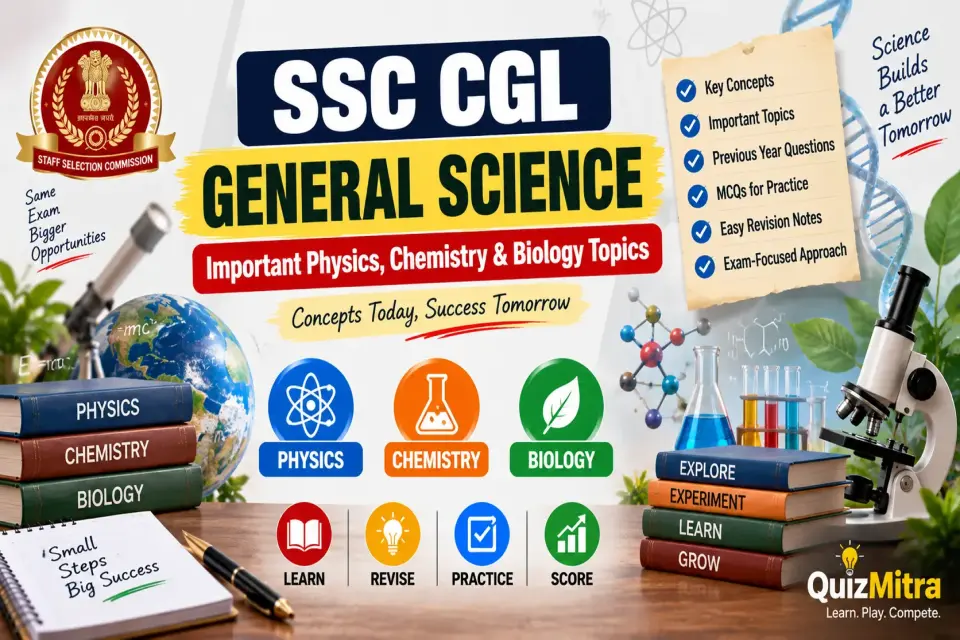
For preparation, it is useful to organise Science into three practical sections: Physics, Chemistry and Biology. Instead of trying to memorise every scientific fact, focus on important concepts, everyday applications, common facts and regular MCQ practice.
In this guide, we will cover the most useful SSC CGL General Science topics, explain what to study in Physics, Chemistry and Biology, and show you how to combine learning, quizzes, PYQs and revision effectively.
Table of Contents
- Why General Science Matters for SSC CGL
- Important SSC CGL General Science Topics
- SSC CGL Physics Topics
- SSC CGL Chemistry Topics
- SSC CGL Biology Topics
- Science & Technology Current Affairs
- Which Science Topics Should You Study First?
- How to Prepare General Science for SSC CGL
- How to Practise SSC CGL Science Questions
- Why SSC CGL Science PYQs Matter
- Common Science Preparation Mistakes
- 30-Minute Daily Science Routine
- SSC CGL General Science Revision Checklist
- Final Strategy
Why General Science Matters for SSC CGL
General Awareness is one of the four sections in SSC CGL Tier-I. The current SSC CGL examination scheme includes 25 General Awareness questions carrying 50 marks, with negative marking for incorrect answers.
The official syllabus does not present Physics, Chemistry and Biology as three completely separate SSC CGL subjects. Instead, it describes General Awareness as covering current events, everyday observations from a scientific perspective and scientific research along with other areas of General Awareness.
This is why your Science preparation should focus on practical, exam-relevant knowledge rather than advanced academic-level science.
A good approach is:
Learn the concept → Practise questions → Check mistakes → Revise → Test again
Important SSC CGL General Science Topics
For preparation purposes, divide General Science into three major areas:
| Subject | Important Areas | Preparation Focus |
|---|---|---|
| Physics | Motion, force, work, energy, heat, light, sound, electricity | Basic concepts and everyday applications |
| Chemistry | Elements, compounds, acids, bases, metals, reactions | Common facts, properties and applications |
| Biology | Human body, cells, diseases, plants, nutrition, environment | Basic concepts and important factual knowledge |
The objective is not to study every chapter with the same depth. Prioritise concepts that are easy to revise, frequently practised in competitive-exam question banks and connected to everyday science.
SSC CGL Physics Topics
Physics can become much easier when you focus on basic concepts and understand how they appear in everyday situations.
1. Motion and Measurement
- Distance and displacement
- Speed and velocity
- Acceleration
- Basic units and measurements
- Motion in everyday life
2. Force and Laws of Motion
- Force
- Mass and inertia
- Momentum
- Newton's laws of motion
- Friction
3. Work, Energy and Power
- Work
- Energy
- Kinetic energy
- Potential energy
- Power
- Everyday applications
4. Heat and Temperature
- Heat and temperature
- Conduction
- Convection
- Radiation
- Changes of state
- Everyday applications of heat
5. Light
- Reflection
- Refraction
- Mirrors
- Lenses
- Human eye basics
- Common optical phenomena
6. Sound
- Production of sound
- Propagation of sound
- Frequency
- Amplitude
- Pitch
- Echo and everyday applications
7. Electricity and Magnetism
- Electric current
- Voltage
- Resistance
- Conductors and insulators
- Basic circuits
- Magnets and magnetic effects
For SSC CGL preparation, try to understand the basic idea behind each topic before memorising related facts. Then test yourself using MCQs.
SSC CGL Chemistry Topics
Chemistry questions can often be approached through basic concepts, common substances, properties of materials and their everyday uses.
1. Matter and Its Properties
- States of matter
- Physical and chemical changes
- Elements and compounds
- Mixtures
- Basic properties of substances
2. Atoms and Molecules
- Basic structure of an atom
- Protons, neutrons and electrons
- Atomic and molecular concepts
- Elements and symbols
3. Acids, Bases and Salts
- Properties of acids
- Properties of bases
- Indicators
- Neutralisation
- Common salts and their uses
4. Metals and Non-Metals
- Physical properties
- Chemical properties
- Uses of common metals
- Corrosion
- Alloys
5. Common Chemical Reactions
- Oxidation
- Reduction
- Combustion
- Rusting
- Everyday chemical reactions
6. Chemistry in Everyday Life
- Soaps and detergents
- Fuels
- Common gases
- Food-related chemistry
- Useful chemicals and their applications
Don't turn Chemistry preparation into a list of disconnected facts. Whenever possible, connect a substance with its property, use or everyday application.
SSC CGL Biology Topics
Biology is particularly useful for General Awareness preparation because many basic concepts are connected to the human body, health, plants, animals and the environment.
1. Cell and Basic Biology
- Cell structure
- Plant and animal cells
- Cell organelles
- Basic biological processes
2. Human Body
- Digestive system
- Respiratory system
- Circulatory system
- Nervous system
- Excretory system
- Endocrine system
- Sense organs
3. Nutrition and Health
- Carbohydrates
- Proteins
- Fats
- Vitamins
- Minerals
- Balanced diet
- Common deficiency diseases
4. Diseases and Immunity
- Common infectious diseases
- Causes of diseases
- Prevention
- Vaccination basics
- Immune system basics
5. Plants
- Photosynthesis
- Plant tissues
- Plant nutrition
- Respiration in plants
- Reproduction in plants
6. Environment and Ecology
- Food chains
- Food webs
- Ecosystems
- Biodiversity
- Pollution
- Conservation
Science becomes easier when you stop memorising everything and start understanding, practising and revising the right things.
Science & Technology Current Affairs
Static Science should not be your entire preparation. Important developments in Science and Technology can also be relevant to General Awareness.
Keep an eye on exam-relevant areas such as:
- Space missions
- Scientific discoveries
- New technologies
- Defence technology
- Important research developments
- Health and medical developments
- Artificial Intelligence and emerging technologies
- Major national scientific initiatives
Don't try to follow every technology story. Focus on important developments that have national or international significance.
You can also combine Science preparation with Daily Current Affairs practice to keep your preparation updated.
Which Science Topics Should You Study First?
If you are short on time, don't try to complete every topic at once. Create a priority list.
| Priority | Area | Focus |
|---|---|---|
| 1 | Biology | Human body, diseases, nutrition, cells and plants |
| 2 | Physics | Motion, force, energy, heat, light, sound and electricity |
| 3 | Chemistry | Atoms, acids, bases, metals, reactions and everyday chemistry |
| 4 | Environment | Ecology, pollution, biodiversity and conservation |
| 5 | Science & Technology Current Affairs | Important recent developments and applications |
This is a practical study order, not an official SSC ranking. Use your own PYQ analysis and quiz performance to adjust your priorities.
How to Prepare General Science for SSC CGL
The best Science preparation strategy combines learning with active testing. Reading a chapter once is not enough because the exam requires you to recall information quickly.
Step 1: Learn the Basic Concept
Start with a simple explanation of the topic. Make sure you understand the concept before moving to factual revision.
Step 2: Create Short Notes
Write only important definitions, facts, examples and confusing points. Your notes should become shorter with every revision.
Step 3: Practise MCQs
After completing a topic, immediately test yourself. This tells you whether you can actually recall what you studied.
Step 4: Analyse Mistakes
Don't just check the correct option. Understand why your answer was wrong and revise the underlying concept.
Step 5: Reattempt Later
Return to difficult questions after a few days. Repeated retrieval is more useful than repeatedly reading the same page.
How to Practise SSC CGL Science Questions
MCQ practice should be part of your learning process, not something you do only after finishing the entire syllabus.
A simple cycle is:
Study → Attempt Quiz → Check Explanation → Record Mistake → Revise → Attempt Again
QuizMitra's online quizzes can be used for regular question practice across General Knowledge, Science and competitive-exam preparation.
The important part is to learn from incorrect answers. If you repeatedly get the same type of Science question wrong, add that concept to your revision list.
Why SSC CGL Science PYQs Matter
Previous Year Questions help you understand how your preparation performs against actual exam-style questions.
Use PYQs to identify:
- Question styles
- Concepts you need to understand better
- Topics where your accuracy is low
- Questions that take too much time
- Facts that you repeatedly forget
Don't simply solve a PYQ set and record the score. Analyse the mistakes and revise the concepts behind them.
You can combine Previous Year Questions with topic-wise quizzes and mock tests for a more complete preparation cycle.
Common SSC CGL Science Preparation Mistakes
1. Studying Advanced Science
SSC CGL General Awareness preparation does not require you to turn every topic into an advanced science course. Focus on the level and style relevant to your examination.
2. Memorising Without Understanding
Memorised facts can be forgotten quickly. Understanding the basic concept gives you a stronger foundation for revision.
3. Ignoring MCQs
Reading alone does not tell you how well you can recall information under question-solving conditions.
4. Making Huge Notes
Very long Science notes can become difficult to revise. Keep important information concise.
5. Never Revisiting Mistakes
Your incorrect answers are valuable revision material. Keep track of repeated mistakes and test those concepts again.
30-Minute Daily SSC CGL Science Routine
You don't need a separate three-hour Science session every day. A short but consistent routine can keep the subject active.
- 10 minutes: Learn one Science concept.
- 5 minutes: Recall the concept without notes.
- 10 minutes: Attempt Science MCQs.
- 5 minutes: Review incorrect answers.
On weekends, use a longer mixed quiz to combine Physics, Chemistry and Biology and identify your weakest area.
SSC CGL General Science Revision Checklist
Before moving on from Science, ask yourself:
- Have I covered the basic Physics concepts?
- Can I explain common Physics applications?
- Have I revised important Chemistry concepts?
- Do I remember common acids, bases, metals and compounds?
- Have I covered the major Biology systems?
- Can I connect diseases with their basic causes or prevention?
- Have I revised important plant and environment topics?
- Am I following important Science & Technology Current Affairs?
- Have I practised enough MCQs?
- Have I reviewed my incorrect answers?
- Have I practised relevant PYQs?
- Have I tested myself with a mock test?
Build a Smarter Science Practice System
General Science becomes much easier when your preparation has a clear feedback loop.
- Learn: Understand one topic.
- Practise: Solve MCQs.
- Analyse: Find incorrect answers.
- Revise: Return to weak concepts.
- Test: Attempt PYQs and mock tests.
- Repeat: Keep improving your accuracy.
QuizMitra brings together quizzes, Current Affairs, Previous Year Questions and mock-test practice so you can turn this cycle into a regular preparation habit.
You can also explore the General Knowledge section for additional topic-based practice.
Final Strategy for SSC CGL General Science
Preparing for SSC CGL General Science does not mean memorising every scientific fact you can find. Build a strong foundation in Physics, Chemistry and Biology, add important environment and Science & Technology topics, and then turn your knowledge into practice through MCQs.
Your preparation should follow a simple cycle: Learn → Practise → Analyse → Revise → Test Again.
Most importantly, use your mistakes as a guide. The questions you cannot answer today can become the topics you master before the examination.
Start with one Science topic today, solve a few questions and gradually build your accuracy.
Quiz Mitra — Learn. Play. Compete.
Frequently Asked Questions
What are the important Science topics for SSC CGL?
Focus on basic Physics, Chemistry and Biology along with environment and relevant Science & Technology developments. Prioritise concepts that are useful for General Awareness and practise them through MCQs.
Is General Science important for SSC CGL?
General Science forms part of the broader General Awareness preparation. The SSC syllabus includes scientific aspects of everyday observations and scientific research within General Awareness.
What should I study first: Physics, Chemistry or Biology?
Start with the subject you find easiest to build momentum, then cover all three. A balanced approach is better than completely ignoring one area.
How can I practise SSC CGL Science questions?
Study a topic first and then attempt topic-wise MCQs. Review incorrect answers and repeat difficult questions after revision.
Are PYQs useful for SSC CGL General Science?
Yes. PYQs help you understand exam-style questions, identify weak areas and improve your ability to apply what you have studied.
How much time should I spend on General Science?
The ideal time depends on your overall preparation and strengths. Consistent short sessions combined with regular quiz practice can be more manageable than occasional long study sessions.
Can quizzes help with SSC CGL Science preparation?
Yes. Quizzes provide active recall practice and help you identify concepts that need additional revision. Use them alongside notes, PYQs and mock tests rather than as your only study resource.