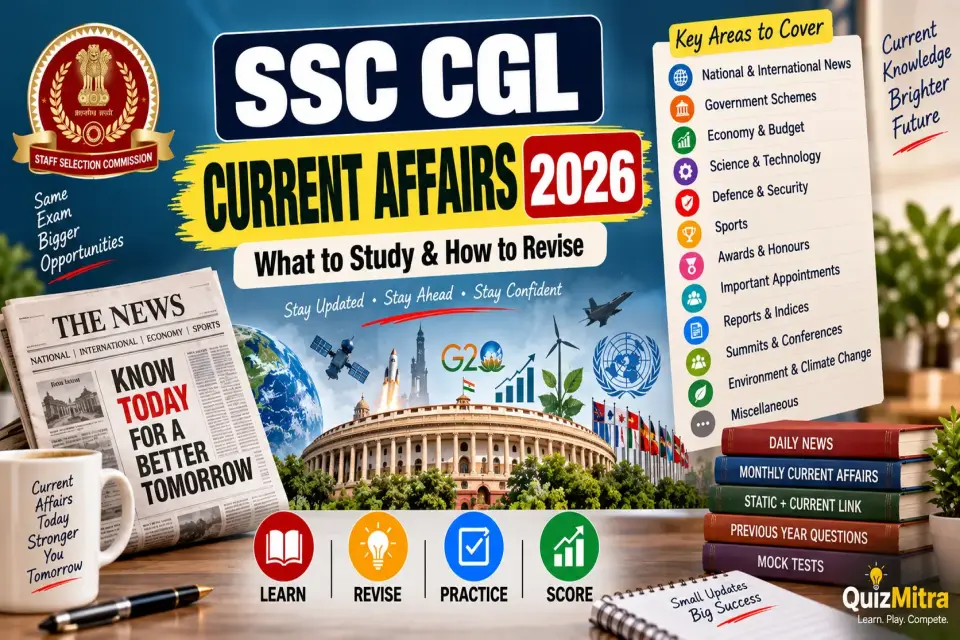
Current Affairs can become one of the most confusing parts of SSC CGL preparation. New government schemes, appointments, awards, sports, economy, science, defence and international events appear every day, making it difficult to decide what is actually worth studying.
The solution is not to read more news. The better approach is to build a simple system around important topics, short notes, regular revision and MCQ practice.
In this guide, you will learn how to prepare SSC CGL Current Affairs 2026, which categories deserve more attention, how to organise monthly current affairs and how to use quizzes and revision to improve your recall.
Table of Contents
- Why Current Affairs Matters for SSC CGL
- What Current Affairs Should You Study?
- Important SSC CGL Current Affairs Topics
- How Many Months of Current Affairs Should You Cover?
- How to Organise Current Affairs Month-Wise
- Daily Current Affairs Study Strategy
- How to Revise Current Affairs Effectively
- Why Current Affairs MCQs Are Important
- Use PYQs to Understand Question Patterns
- Common Current Affairs Mistakes
- 30-Day SSC CGL Current Affairs Revision Plan
- Final Current Affairs Checklist
- Final Strategy
Why Current Affairs Matters for SSC CGL
The SSC CGL General Awareness syllabus includes questions related to current events along with areas such as History, Culture, Geography, Economic Scene, General Policy and Scientific Research.
This means Current Affairs should not be treated as an optional subject that you start studying only a few weeks before the examination. Instead, build it into your regular General Awareness routine.
The biggest advantage of Current Affairs preparation is consistency. A short daily session followed by weekly and monthly revision can be much easier to manage than trying to memorise several months of news at the last moment.
What Current Affairs Should You Study for SSC CGL?
You do not need to remember every news story that appears online. Your objective should be to identify information that can be converted into useful General Awareness questions.
Focus on events that involve an important person, organisation, government initiative, award, report, institution, country, place, achievement or major development.
A useful question to ask while reading any news item is:
Can this information be converted into a clear one-line MCQ?
If the answer is yes, add it to your revision list. If it is detailed, opinion-based or unlikely to help your examination preparation, don't spend excessive time on it.
Important SSC CGL Current Affairs Topics
Organising Current Affairs into categories makes revision much easier. Instead of remembering hundreds of unrelated headlines, create a few familiar buckets.
| Topic | What to Focus On | Revision Method |
|---|---|---|
| Government Schemes | Scheme, ministry, objective, target group and major updates | Make short fact tables |
| Appointments | Important national and international appointments | Person + post + organisation |
| Awards | Major awards, winners and categories | Use one-line notes |
| Sports | Major tournaments, winners, records and important players | Event + winner + venue |
| Economy | Important economic developments, banking and financial updates | Connect facts with basic concepts |
| Science & Technology | Major discoveries, missions, technologies and developments | Focus on important facts |
| Defence | Exercises, defence systems, organisations and major developments | Country + exercise + organisation |
| Reports & Indexes | Report name, organisation, purpose and important findings | Report + organisation + theme |
| International Affairs | Summits, organisations, agreements and major events | Country + organisation + event |
| Important Days | Dates, themes and significance | Quick monthly revision |
How Many Months of Current Affairs Should You Cover?
There is no universal number of months that guarantees coverage of every Current Affairs question in an examination. The right coverage depends on your preparation time and how close you are to the exam.
A practical approach is to build a strong revision base from the most recent 6 months and expand to older months if you have enough preparation time.
| Your Situation | Suggested Approach | Priority |
|---|---|---|
| Very little time | Focus deeply on recent months and important categories | Revision + MCQs |
| 2–3 months available | Cover recent 6 months systematically | Monthly revision |
| 4–6 months available | Cover recent months and gradually add older important events | Weekly + monthly revision |
| Long preparation window | Build current affairs continuously from the beginning | Daily habit |
Remember that deep revision is more useful than collecting unlimited PDFs. A smaller set of well-organised notes that you revise multiple times is easier to remember than several sources that you read only once.
How to Organise Current Affairs Month-Wise
Create one section for every month. Within each month, divide the news into categories such as schemes, appointments, awards, sports, economy, defence, science and international affairs.
Your monthly notes can follow a simple structure:
- Government Schemes — scheme, ministry and purpose.
- Appointments — person, position and organisation.
- Awards — award, winner and field.
- Sports — tournament, winner and important record.
- Economy — major financial and economic updates.
- Science & Technology — important developments.
- Defence — exercises and major developments.
- Reports & Indexes — organisation and key information.
- International Affairs — summits and major events.
- Important Days — date and theme where relevant.
This structure makes your revision much faster because your brain starts connecting similar information together.
Daily Current Affairs Study Strategy
Current Affairs should become a small daily habit rather than a large weekly burden.
A simple daily session can take around 20–30 minutes:
- 10 minutes: Read important current events.
- 5 minutes: Write or highlight only important facts.
- 10 minutes: Attempt a Current Affairs quiz.
- 5 minutes: Review incorrect answers.
QuizMitra provides Daily, Weekly and Monthly Current Affairs quizzes so you can turn reading into active question practice.
How to Revise Current Affairs Effectively
Reading Current Affairs once is not enough. The real challenge is remembering information several weeks later.
Use a simple revision cycle:
Read → Recall → Quiz → Correct → Revise → Repeat
Quick Revision
Review the facts you studied recently. Try to recall the answer before looking at your notes.
Weekly Revision
At the end of every week, revise the important events from the entire week and attempt a mixed quiz.
Monthly Revision
At the end of the month, compress your notes into a shorter revision sheet containing only the most important facts.
Wrong-Answer Revision
Maintain a separate list of Current Affairs questions you repeatedly get wrong. These should become your highest-priority revision points.
Why Current Affairs MCQs Are Important
One of the biggest mistakes aspirants make is reading Current Affairs without testing themselves.
A quiz forces you to retrieve information from memory. This tells you whether you actually remember the fact or whether it only feels familiar because you have read it before.
After completing a quiz, divide your questions into three groups:
- Correct and confident: Continue with normal revision.
- Correct but unsure: Add to your revision list.
- Incorrect: Understand and revise the fact.
QuizMitra's Current Affairs quizzes provide written explanations after answering, allowing you to use mistakes as part of your learning process. :contentReference[oaicite:2]{index=2}
Use PYQs to Understand Question Patterns
Previous Year Questions should be part of your Current Affairs preparation because they show you how General Awareness information can be turned into exam questions.
When analysing PYQs, look for:
- Types of factual questions
- Important categories
- Question wording
- Static GK connected with current events
- Topics where your accuracy is low
Use QuizMitra Previous Year Questions after studying a topic and then follow them with quizzes for additional recall practice.
Connect Current Affairs With Static GK
Current Affairs becomes easier to remember when you connect new information with something you already know.
For example, if you read about a government organisation, revise its basic role. If you study an international summit, identify the participating countries and organisation. If you read about a report, remember which organisation publishes it.
This creates a connection between Current Affairs and Static GK instead of keeping every fact as an isolated piece of information.
You can strengthen this foundation through QuizMitra's General Knowledge practice.
Common SSC CGL Current Affairs Mistakes
1. Trying to Read Everything
You cannot realistically remember every news story. Focus on exam-relevant information and avoid spending too much time on unnecessary details.
2. Using Too Many Sources
Switching between multiple PDFs, websites and channels can create duplicate information and scattered notes. Choose a consistent source structure.
3. No Revision System
Reading today's news does not guarantee that you will remember it next month. Schedule weekly and monthly revision.
4. Ignoring MCQs
Current Affairs is a memory-heavy area, so active recall is essential. Test yourself regularly instead of only reading.
5. Collecting PDFs Instead of Studying
Downloading another PDF feels productive, but it does not improve recall unless you actually revise and test the information.
6. Not Reviewing Wrong Answers
Every incorrect answer gives you information about your weak area. Record it and revisit it during your next revision session.
30-Day SSC CGL Current Affairs Revision Plan
If you already have Current Affairs notes, use the next 30 days to organise, revise and test what you know rather than continuously collecting new material.
| Days | Focus | What to Do |
|---|---|---|
| 1–5 | Recent Current Affairs | Revise important categories and solve daily MCQs |
| 6–10 | Previous Month | Revise notes and practise mixed quizzes |
| 11–15 | Older Current Affairs | Focus on high-priority events and weak topics |
| 16–20 | Category Revision | Revise schemes, awards, appointments, sports and reports |
| 21–25 | Science, Defence & Economy | Revise important developments and solve MCQs |
| 26–28 | Mixed Revision | Attempt mixed Current Affairs quizzes |
| 29 | Wrong Answers | Revise only the facts you repeatedly forget |
| 30 | Final Test | Attempt a full Current Affairs revision test |
How to Use QuizMitra for SSC CGL Current Affairs
Current Affairs preparation becomes more effective when you move from reading to testing.
- Read: Study important current events.
- Practise: Attempt a Daily Current Affairs quiz.
- Analyse: Check incorrect answers and explanations.
- Revise: Add difficult facts to your revision list.
- Repeat: Return to older quizzes during weekly and monthly revision.
QuizMitra currently provides daily, weekly and monthly Current Affairs practice, along with competitive-exam quizzes, PYQs and mock tests. :contentReference[oaicite:3]{index=3}
Start with Today's Current Affairs, then use weekly and monthly practice to strengthen your recall.
SSC CGL Current Affairs Final Checklist
Before your examination, make sure you can confidently revise:
- Important government schemes
- Major appointments
- Important awards and honours
- Major sports events and achievements
- Important economic developments
- Banking and financial updates
- Major defence exercises and developments
- Important Science & Technology developments
- Major reports and indexes
- Important national events
- Important international events
- Major summits and organisations
- Important days and themes
- Environment-related developments
- Your own wrong-answer list
The Best Current Affairs Revision Formula
Don't make Current Affairs complicated. Use a repeatable system:
Read → Note → Quiz → Analyse → Revise → Repeat
The purpose of each step is simple. Reading gives you information, notes organise it, quizzes test recall, analysis exposes mistakes and revision helps you remember the information for longer.
This approach is much more useful than continuously searching for new Current Affairs PDFs without revisiting the information you already studied.
Final Strategy for SSC CGL Current Affairs 2026
Preparing SSC CGL Current Affairs 2026 does not mean memorising every event that happens in the world. Your goal should be to identify important information, organise it by category, revise it regularly and test yourself through MCQs.
Start with recent Current Affairs, build a strong monthly revision system and gradually cover older important events if your preparation time allows.
Most importantly, don't measure your preparation by how many articles or PDFs you have read. Measure it by how many questions you can answer correctly and how well you remember the facts after revision.
Start today's Current Affairs practice now and make it a daily habit.
Quiz Mitra — Learn. Play. Compete.
Frequently Asked Questions
How should I prepare Current Affairs for SSC CGL 2026?
Focus on important categories such as government schemes, appointments, awards, sports, economy, defence, science and technology, reports, international events and important days. Revise regularly and practise MCQs.
How many months of Current Affairs should I study for SSC CGL?
A practical starting point is the most recent six months, especially when time is limited. If you have more preparation time, expand your coverage and revise older important events as well.
Is daily Current Affairs practice useful for SSC CGL?
Yes. Daily practice prevents a large backlog from building up and gives you regular opportunities to test your memory.
Which Current Affairs topics are important for SSC CGL?
Government schemes, appointments, awards, sports, economy, banking, defence, Science & Technology, reports, indexes, international affairs and important days are useful categories to include in your preparation.
Should I make Current Affairs notes?
Yes, but keep them short. Notes should make revision faster rather than become another large book that is difficult to complete.
Are Current Affairs quizzes useful for SSC CGL?
Yes. Quizzes turn passive reading into active recall and help identify facts that you have forgotten or confused.
Should I use Previous Year Questions for Current Affairs preparation?
Yes. PYQs can help you understand how General Awareness information is converted into exam questions and can reveal areas where your preparation needs improvement.