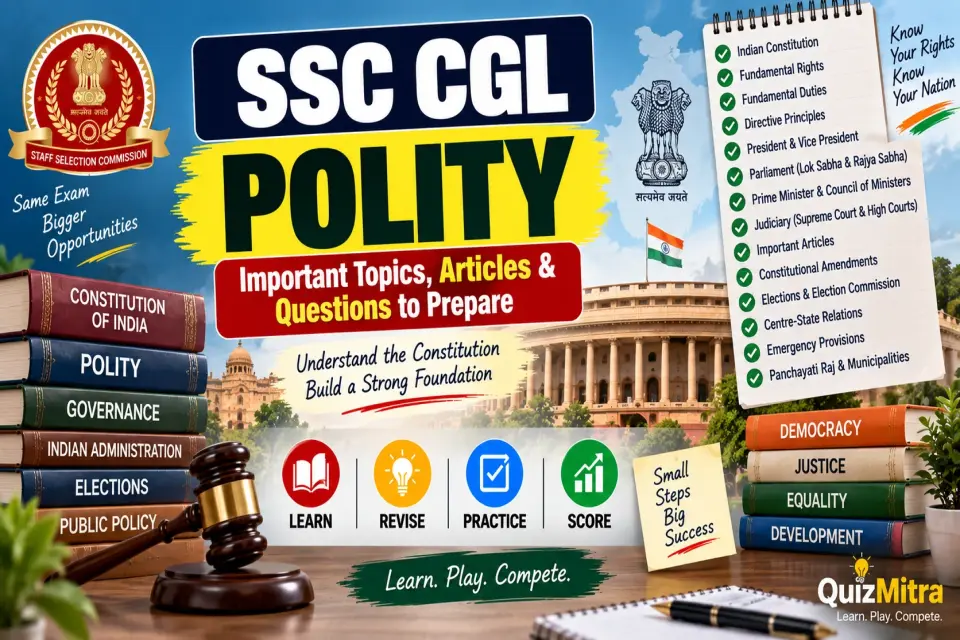
SSC CGL Polity is an important part of General Awareness preparation. If you understand the Indian Constitution, Fundamental Rights, Parliament, President, Prime Minister, Judiciary, Constitutional Bodies and important Articles properly, many Polity questions become much easier to solve.
The official SSC CGL General Awareness syllabus includes questions related to General Policy along with History, Culture, Geography, Economic Scene, Scientific Research and current events. This makes Indian Polity an important area for candidates preparing for SSC CGL.
In this guide, you will find the most important SSC CGL Polity topics, important Constitutional Articles, preparation strategies, revision methods and a practical MCQ-based approach.
Table of Contents
- Why SSC CGL Polity Is Important
- SSC CGL Polity: Important Topics
- Indian Constitution
- Preamble of the Constitution
- Fundamental Rights
- Fundamental Duties
- Directive Principles of State Policy
- President and Vice President
- Prime Minister and Council of Ministers
- Parliament of India
- Supreme Court and High Courts
- Constitutional and Statutory Bodies
- Important Constitutional Articles
- Constitutional Amendments
- Centre-State Relations
- Election Commission and Elections
- Emergency Provisions
- Panchayati Raj and Municipalities
- How to Prepare SSC CGL Polity
- How to Use MCQs for Polity Preparation
- Common Mistakes to Avoid
- 30-Day SSC CGL Polity Revision Plan
- Final Checklist
- Frequently Asked Questions
Why SSC CGL Polity Is Important
Polity is one of the most useful areas to prepare within General Awareness. Unlike rapidly changing current affairs, many basic Polity concepts remain stable and can be revised repeatedly.
A strong foundation in Indian Polity can help you answer questions based on the Constitution, government institutions, rights and duties, Parliament, Judiciary, elections and important constitutional provisions.
The best approach is not to memorize hundreds of facts randomly. Instead, understand the basic structure first and then revise important Articles, institutions and frequently tested concepts through questions.
SSC CGL Polity: Important Topics
Start your preparation with the following high-value areas:
| Topic | What to Prepare |
|---|---|
| Indian Constitution | Features, structure, schedules and important provisions |
| Preamble | Key words, objectives and constitutional significance |
| Fundamental Rights | Types of rights and important Articles |
| Fundamental Duties | Article 51A and important provisions |
| DPSP | Directive Principles and their classification |
| President | Election, powers, tenure and impeachment |
| Prime Minister | Role, powers and Council of Ministers |
| Parliament | Lok Sabha, Rajya Sabha, Bills and parliamentary procedures |
| Judiciary | Supreme Court, High Courts and judicial review |
| Constitutional Bodies | Election Commission, CAG, UPSC and Finance Commission |
| Emergency | National, State and Financial Emergency provisions |
| Local Government | Panchayats and Municipalities |
Indian Constitution
The Constitution is the foundation of India's political and administrative system. For SSC CGL preparation, focus on its major features rather than trying to memorize every provision at once.
Important areas include:
- Constitutional structure
- Fundamental Rights
- Directive Principles
- Fundamental Duties
- Union and State Government
- Judiciary
- Constitutional Bodies
- Emergency provisions
- Amendment procedure
- Schedules and important Articles
Preamble of the Constitution
The Preamble provides a broad description of the objectives and values of the Indian Constitution.
SSC CGL aspirants should understand important terms associated with the Preamble and remember the constitutional changes related to it.
Do not simply memorize individual words. Understand what the Preamble represents and how it relates to the constitutional framework.
Fundamental Rights
Fundamental Rights are among the most important areas of Indian Polity for competitive examinations.
Focus on:
- Right to Equality
- Right to Freedom
- Right against Exploitation
- Right to Freedom of Religion
- Cultural and Educational Rights
- Right to Constitutional Remedies
Pay special attention to the Articles associated with these rights and understand the difference between various rights instead of learning them only as isolated facts.
Fundamental Duties
Fundamental Duties are another important Polity topic that can be prepared relatively quickly.
Candidates should understand the purpose of Fundamental Duties, their constitutional location and the major provisions associated with them.
Revision through MCQs is particularly useful because questions can test the number, nature or constitutional provision associated with duties.
Directive Principles of State Policy
Directive Principles of State Policy provide guidelines for governance and are an important part of the constitutional framework.
Prepare:
- Meaning of DPSP
- Constitutional Articles
- Classification of Directive Principles
- Relationship between Fundamental Rights and DPSP
- Important constitutional amendments related to DPSP
President and Vice President
The President is the constitutional head of the Union executive. SSC CGL preparation should cover the election process, tenure, qualifications, powers and impeachment procedure.
Important areas include:
- Election of the President
- Term of office
- Qualifications
- Executive powers
- Legislative powers
- Ordinance-making power
- Impeachment
- Vice President and his constitutional role
Prime Minister and Council of Ministers
The Prime Minister plays a central role in the Union executive. Understand the relationship between the President, Prime Minister and Council of Ministers.
Focus on the appointment of the Prime Minister, role of the Council of Ministers, collective responsibility and the basic functioning of the parliamentary system.
Parliament of India
Parliament is one of the most important areas for SSC CGL Polity preparation.
Prepare the following topics:
- Lok Sabha
- Rajya Sabha
- Composition and tenure
- Speaker and Deputy Speaker
- Chairman of Rajya Sabha
- Ordinary Bills
- Money Bills
- Constitution Amendment Bills
- Parliamentary Committees
- Question Hour
- Zero Hour
- Joint Sitting
Supreme Court and High Courts
The Indian Judiciary is another important section of Polity. Candidates should understand the structure and basic powers of the Supreme Court and High Courts.
- Supreme Court
- High Courts
- Judicial Review
- Judicial Activism
- Writs
- Appointment of Judges
- Removal of Judges
- Jurisdiction of Courts
Constitutional and Statutory Bodies
Questions about constitutional and statutory bodies are useful for General Awareness preparation.
| Body | What to Study |
|---|---|
| Election Commission | Role and election-related functions |
| UPSC | Constitutional status and functions |
| CAG | Role and audit responsibilities |
| Finance Commission | Purpose and constitutional role |
| Attorney General | Constitutional position and functions |
| National Commissions | Basic role and constitutional/statutory basis |
Important Constitutional Articles for SSC CGL
You do not need to memorize every Article of the Constitution. Start with commonly studied Articles and understand what each one represents.
| Article | Important Area |
|---|---|
| Article 14 | Equality before law |
| Article 19 | Freedom-related rights |
| Article 21 | Protection of life and personal liberty |
| Article 32 | Constitutional remedies |
| Article 44 | Uniform Civil Code under DPSP |
| Article 51A | Fundamental Duties |
| Article 52 | The President of India |
| Article 74 | Council of Ministers to aid and advise the President |
| Article 76 | Attorney General of India |
| Article 110 | Money Bill |
| Article 123 | Ordinance-making power of President |
| Article 148 | Comptroller and Auditor General |
| Article 280 | Finance Commission |
| Article 324 | Election Commission |
| Article 368 | Constitutional amendment |
Treat this table as a revision starting point. The goal should be to understand the constitutional provision rather than blindly memorizing a long list of Article numbers.
Constitutional Amendments
Constitutional Amendments can appear in competitive examination questions, particularly when a question connects an amendment with an important constitutional change.
Build a small revision list of major amendments and learn the change associated with each one. Avoid trying to memorize every amendment without understanding its importance.
Centre-State Relations
Understand how powers and responsibilities are distributed between the Union and the States.
Focus on:
- Legislative relations
- Administrative relations
- Financial relations
- Union, State and Concurrent Lists
- Inter-State relations
- Role of the Governor
Election Commission and Elections
Elections are an important part of Indian Polity and should be studied along with the constitutional role of the Election Commission.
Prepare:
- Election Commission of India
- Electoral process
- Lok Sabha and State Assembly elections
- Election-related constitutional provisions
- Voting and representation concepts
- Important election terminology
Emergency Provisions
Emergency provisions are frequently included in Indian Polity study material because they connect constitutional provisions with the functioning of government during exceptional situations.
- National Emergency
- President's Rule
- Financial Emergency
- Conditions for proclamation
- Parliamentary approval
- Effects on government and constitutional rights
Panchayati Raj and Municipalities
Local government is another useful area for SSC CGL Polity preparation. Understand the basic structure of rural and urban local bodies.
- Gram Panchayat
- Panchayat Samiti
- Zila Parishad
- Municipal Corporation
- Municipality
- Constitutional amendments related to local government
- Basic functions of local bodies
Don't try to memorize all of Polity at once — understand the Constitution, revise important Articles, and practice questions repeatedly.
How to Prepare SSC CGL Polity
A simple three-step approach works well for Polity preparation:
1. Understand
First understand the concept. For example, before memorizing the powers of Parliament, understand how Lok Sabha and Rajya Sabha function.
2. Revise
Create short revision notes containing Articles, constitutional bodies, important amendments and key concepts.
3. Practice
Solve MCQs after every topic. Questions help you identify confusing concepts and improve recall.
Use MCQs to Strengthen Polity Preparation
Reading Polity repeatedly is not enough. You should regularly test yourself with multiple-choice questions.
Start with topic-wise questions and gradually move toward mixed General Awareness quizzes.
After every quiz, review the questions you answered incorrectly. Maintain a small Polity Mistake List containing:
- Wrong answers
- Confusing Articles
- Frequently forgotten facts
- Similar constitutional provisions
- Questions requiring repeated revision
You can use Quiz Mitra quizzes for regular General Knowledge and competitive-exam practice.
SSC CGL Polity: PYQ Strategy
Previous Year Questions are useful because they show how concepts are converted into actual examination questions.
While solving PYQs, do not only check whether your answer is correct. Ask yourself:
- Why is this option correct?
- Why are the other options incorrect?
- Which Article or constitutional concept is involved?
- Can a similar question be asked differently?
Practice more questions from topics where your accuracy remains low. You can also use the Quiz Mitra Previous Year Questions section for structured practice.
Common Mistakes in SSC CGL Polity Preparation
Mistake 1: Memorizing Without Understanding
Memorizing Article numbers without understanding their meaning can create confusion.
Mistake 2: Ignoring PYQs
Only reading notes does not tell you how well you can apply your knowledge in an examination.
Mistake 3: Studying Too Many Sources
Switching between multiple books, videos and notes can waste valuable preparation time. Choose a reliable source and revise it multiple times.
Mistake 4: Not Revising
Polity contains many similar terms and provisions. Regular revision is essential for long-term recall.
Mistake 5: Avoiding Current Affairs
Polity preparation should not be completely isolated from current events. Government institutions, constitutional developments and important national issues can help connect static concepts with real-world events.
30-Day SSC CGL Polity Revision Plan
| Days | Focus Area |
|---|---|
| Day 1–3 | Constitution and Preamble |
| Day 4–7 | Fundamental Rights and Duties |
| Day 8–10 | DPSP and important Articles |
| Day 11–14 | President, Vice President and Prime Minister |
| Day 15–18 | Parliament and Parliamentary Procedures |
| Day 19–21 | Supreme Court and High Courts |
| Day 22–24 | Constitutional Bodies and Elections |
| Day 25–26 | Centre-State Relations and Local Government |
| Day 27 | Emergency Provisions |
| Day 28 | Important Articles and Amendments |
| Day 29 | PYQs and Topic-wise MCQs |
| Day 30 | Full Polity Revision + Mock Quiz |
Your SSC CGL Polity Preparation Checklist
- Understand the basic structure of the Constitution
- Revise the Preamble
- Prepare Fundamental Rights
- Revise Fundamental Duties
- Understand DPSP
- Study President and Prime Minister
- Prepare Lok Sabha and Rajya Sabha
- Study Supreme Court and High Courts
- Revise important Constitutional Articles
- Prepare important Constitutional Bodies
- Study Emergency provisions
- Understand Centre-State Relations
- Practice Previous Year Questions
- Take regular Polity MCQ quizzes
- Revise your mistakes regularly
Practice SSC CGL Polity with Quiz Mitra
Preparation becomes more effective when you combine learning with regular testing.
After studying a Polity topic, move directly to questions. This helps you check your understanding, identify weak areas and improve recall.
Explore General Knowledge quizzes and Competitive Exam practice on Quiz Mitra.
You can also combine your Polity preparation with Previous Year Questions and Mock Tests for broader exam practice.
Final Strategy: Learn → Revise → Practice → Analyse
The best way to prepare SSC CGL Polity is to avoid treating it as a collection of isolated facts.
First understand the constitutional system. Then revise important Articles, institutions and provisions. After that, solve MCQs and Previous Year Questions. Finally, analyse your mistakes and revise your weak topics again.
Even a short daily Polity practice session can become powerful when it is consistent.
Learn. Practice. Revise. Improve.
Quiz Mitra — Learn. Play. Compete.
Frequently Asked Questions
Is Polity important for SSC CGL?
Yes. Indian Polity is an important preparation area within General Awareness because the SSC syllabus includes General Policy and questions related to India and its neighbouring countries.
Which Polity topics should I study first?
Start with the Constitution, Preamble, Fundamental Rights, Fundamental Duties, DPSP, President, Prime Minister, Parliament and Judiciary. Then move to Constitutional Bodies, Elections, Emergency and Local Government.
Should I memorize all Constitutional Articles?
No. Begin with important and frequently studied Articles and understand their meaning. Expand your list gradually through practice questions and revision.
Are Polity MCQs useful for SSC CGL preparation?
Yes. MCQs help you test recall, identify weak topics and become familiar with different ways a concept can be asked.
Should I solve PYQs for Polity?
Absolutely. PYQs help you understand question patterns and show which concepts you need to revise more carefully.