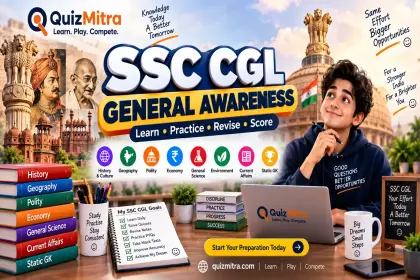
General Awareness is one of the most important sections of SSC CGL preparation. But the syllabus can feel huge because it covers history, geography, polity, economy, science, culture and current affairs.
The solution is not to study everything randomly. A better approach is to understand the SSC CGL General Awareness syllabus, divide it into manageable topics, identify high-priority areas and practise questions regularly.
In this guide, we will break down the SSC CGL General Awareness syllabus 2026, explain what to study first and show you how to combine revision, PYQs and quizzes for better preparation.
Table of Contents
- SSC CGL General Awareness Exam Pattern
- SSC CGL General Awareness Syllabus 2026
- History and Culture
- Geography
- Indian Polity and General Policy
- Economy and Economic Scene
- General Science and Scientific Research
- Current Affairs
- Static GK and Important Facts
- What Should You Study First?
- How to Use Quizzes for SSC CGL GA
- Common SSC CGL GA Preparation Mistakes
- Simple Daily GA Routine
- Final Strategy
SSC CGL General Awareness Exam Pattern
According to the SSC CGL 2026 examination notice, General Awareness is one of the four sections of Tier-I.
- Questions: 25
- Maximum Marks: 50
- Sectional Time: 15 minutes
- Negative Marking: 0.50 marks for each wrong answer
This makes accuracy extremely important. You should not prepare General Awareness only by reading. Regular question practice helps you discover which topics you actually remember.
SSC CGL General Awareness Syllabus 2026
The official SSC syllabus describes General Awareness as testing knowledge of the environment around candidates, current events and everyday observations with a scientific perspective.
It specifically mentions areas related to India and neighbouring countries, particularly:
- History
- Culture
- Geography
- Economic Scene
- General Policy
- Scientific Research
- Current Events
Instead of treating these as one huge subject, divide your preparation into separate study blocks.
1. History and Culture
History is a major part of SSC General Awareness preparation. Focus on important events, personalities, movements, dynasties and cultural developments rather than trying to memorise every historical detail.
Important areas to cover
- Ancient Indian History
- Medieval Indian History
- Modern Indian History
- Indian Freedom Movement
- Important rulers and dynasties
- Important historical events
- Art and Culture
- Dance, music and festivals
- Important monuments and heritage sites
After studying a topic, solve questions instead of immediately moving to another chapter. This helps you discover which facts you can actually recall.
2. Geography
Geography preparation should combine basic concepts with important facts about India and the world.
- Physical Geography
- Indian Geography
- Rivers and lakes
- Mountains and plateaus
- Climate and monsoon
- Soils and agriculture
- Mineral resources
- States and important locations
- World geography basics
Maps can be particularly useful for geography because visual memory can make locations easier to remember.
3. Indian Polity and General Policy
For polity, concentrate on the basic structure of the Indian Constitution and important constitutional and governance concepts.
- Indian Constitution
- Fundamental Rights
- Fundamental Duties
- Directive Principles
- President and Vice-President
- Prime Minister and Council of Ministers
- Parliament
- Supreme Court
- Constitutional bodies
- Important Articles and Schedules
- Election system
- Central and State Government
Do not try to memorise isolated constitutional facts without understanding their basic meaning. Conceptual understanding makes revision much easier.
4. Economy and Economic Scene
Economic topics can look difficult initially, but SSC-level preparation becomes easier when you first understand the basic terminology.
- GDP and national income
- Inflation
- Banking basics
- RBI and monetary policy
- Fiscal policy
- Budget basics
- Taxes
- Financial institutions
- Employment and unemployment
- Government economic schemes
Current economic events should also be connected with your static concepts. For example, if you study inflation, understand the basic concept first and then follow important current developments related to it.
5. General Science and Scientific Research
General Science is another important area for SSC aspirants. You do not need advanced-level science for most General Awareness preparation. Concentrate on concepts and everyday applications.
Physics
- Motion and force
- Work, energy and power
- Light
- Sound
- Heat
- Electricity
Chemistry
- Elements and compounds
- Acids and bases
- Metals and non-metals
- Common chemical reactions
- Everyday chemistry
Biology
- Human body
- Nutrition
- Diseases
- Plants
- Cells
- Genetics basics
- Environment and ecology
Short MCQ practice is especially useful for science because it quickly reveals which facts and concepts need revision.
6. Current Affairs for SSC CGL
Current Affairs should not be treated as a separate subject that you cram at the end of your preparation. Build it into your daily routine.
Focus on exam-relevant areas such as:
- Government schemes
- Important appointments
- Awards and honours
- Sports
- National and international events
- Science and technology
- Defence
- Economy and banking
- Important reports and indexes
- Important days and themes
Quiz Mitra provides Daily Current Affairs along with weekly and monthly revision options. Use these as short question-based revision sessions instead of only reading long news lists.
Don't try to remember everything. Learn the right topics, test yourself and revise what you get wrong.
7. Static GK and Important Facts
Static GK contains facts that generally do not change frequently. These topics can be valuable for quick revision.
- Countries and capitals
- National symbols
- Important organisations
- Books and authors
- Important personalities
- States and capitals
- Important places
- Sports-related facts
- Important days
- World geography facts
Quiz Mitra's Static GK quizzes can be used for short practice and revision.
What Should You Study First for SSC CGL GA?
One of the biggest preparation mistakes is studying topics randomly. Instead, create a repeatable study order.
- Start with General Science fundamentals.
- Build your Indian History foundation.
- Study Indian Polity systematically.
- Cover Indian Geography and important world geography.
- Learn basic Economy concepts.
- Build Static GK through short revision sessions.
- Add Current Affairs every day.
- Use PYQs and quizzes to test everything.
The exact order can change depending on your strengths and weaknesses. The important point is to avoid spending most of your preparation time on one subject while ignoring the others.
How to Use Quizzes for SSC CGL General Awareness
Reading notes gives you information. Attempting questions tells you whether you can actually recall that information.
A simple practice cycle is:
Learn → Quiz → Check Mistakes → Revise → Quiz Again
Use SSC practice quizzes for mixed practice and browse more quizzes when you want to practise a specific subject.
For broader preparation, combine quizzes with Previous Year Questions and mock tests.
Do not look only at your final score. Make a small list of questions you answered incorrectly. Those questions show exactly where your revision should go next.
Common SSC CGL GA Preparation Mistakes
1. Trying to Study Everything
General Awareness is broad. Trying to memorise every available fact can waste time. Prioritise exam-relevant topics.
2. Reading Without Testing
If you never test yourself, it is difficult to know whether information has actually been remembered.
3. Ignoring PYQs
Previous Year Questions help you understand the type and level of questions you need to practise.
4. Making Huge Notes
Notes should make revision faster, not become another giant textbook.
5. Leaving Current Affairs for the End
Daily short sessions are usually easier to manage than trying to remember months of current events in one sitting.
Simple Daily SSC CGL GA Routine
You do not need to spend your entire day on General Awareness. A consistent routine can be much easier to maintain.
- 20 minutes: Learn one static topic.
- 15 minutes: Revise Current Affairs.
- 15 minutes: Attempt a short quiz.
- 10 minutes: Review incorrect answers.
- 5 minutes: Revise yesterday's mistakes.
The most important part is consistency. Even a short daily routine becomes powerful when you continue it for several weeks.
Build Your SSC CGL GA Practice System
Your preparation should not depend on one resource. Use different tools for different purposes:
- Learn: Study the topic and understand the basics.
- Practise: Solve topic-wise MCQs.
- Test: Attempt SSC quizzes and mock tests.
- Analyse: Find repeated mistakes.
- Revise: Return to weak topics.
- Repeat: Test yourself again.
Quiz Mitra brings quizzes, Current Affairs, PYQs, mock tests and progress tracking together, making it easier to turn this process into a regular study habit.
Final Strategy for SSC CGL General Awareness
The SSC CGL General Awareness syllabus looks large, but you do not need to master everything at once. Break it into History, Geography, Polity, Economy, Science, Static GK and Current Affairs.
Study one topic at a time, practise questions, analyse your mistakes and revise weak areas regularly.
The biggest advantage comes from turning preparation into a daily system rather than depending on last-minute revision.
Start with one topic today, attempt a few questions and keep improving your accuracy.
Quiz Mitra — Learn. Play. Compete.