
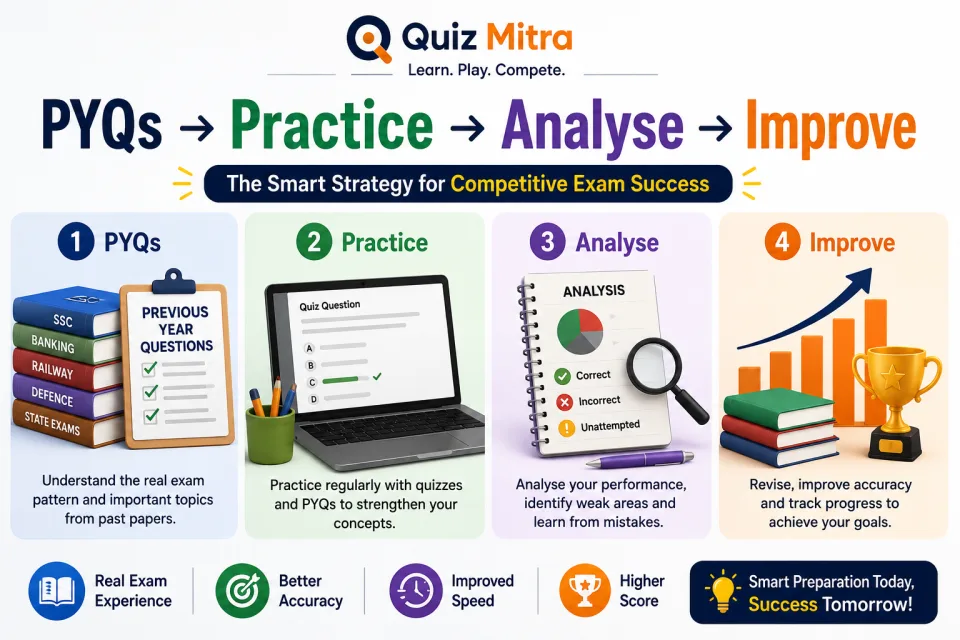
Preparing for a competitive exam is not only about studying more chapters.
It is also about understanding what the exam actually asks. This is where
Previous Year Questions (PYQs) become extremely useful.
Many students collect previous year papers but don't use them effectively.
They solve a paper, check the score and move on. A better approach is to
analyse the questions, identify recurring topics and use the results to
improve your preparation strategy.
Whether you're preparing for SSC, Banking, Railway or another competitive examination, PYQs can help you study with a much clearer direction.
Whether you're preparing for SSC, Banking, Railway or another competitive examination, PYQs can help you study with a much clearer direction.
Table of Contents
Why Are Previous Year Questions Important?
Previous Year Questions give you a practical view of the examination.
Books and study materials can contain thousands of facts, formulas and concepts. PYQs help you understand which types of concepts are actually tested in the exam.
By solving them regularly, you can become familiar with:
You can practise a collection of Previous Year Questions on Quiz Mitra and use them as part of your regular preparation.
Books and study materials can contain thousands of facts, formulas and concepts. PYQs help you understand which types of concepts are actually tested in the exam.
By solving them regularly, you can become familiar with:
- Question patterns
- Frequently tested concepts
- Difficulty levels
- Common question formats
- Time pressure
- Your own weak areas
You can practise a collection of Previous Year Questions on Quiz Mitra and use them as part of your regular preparation.
Don't just solve PYQs. Study what the questions are trying to teach you.
Understand the Exam Pattern
One of the biggest advantages of solving previous year questions is
understanding the style of the examination.
After solving several papers, you may start noticing patterns in the way questions are framed.
For example, you can analyse:
This information can help you create a more focused study plan instead of giving equal time to every topic.
After solving several papers, you may start noticing patterns in the way questions are framed.
For example, you can analyse:
- Which subjects appear most often
- Which topics are repeatedly tested
- What type of questions are difficult for you
- How much time you need for different sections
- Which questions can be solved quickly
This information can help you create a more focused study plan instead of giving equal time to every topic.
Find Frequently Asked Topics
Not every topic deserves exactly the same amount of your preparation time.
While you should build a strong overall understanding of the syllabus, analysing PYQs can help you identify areas that appear repeatedly.
Create a simple list after every practice session:
This approach can make your preparation more organised and reduce the feeling of being overwhelmed by a large syllabus.
While you should build a strong overall understanding of the syllabus, analysing PYQs can help you identify areas that appear repeatedly.
Create a simple list after every practice session:
- Frequently asked: revise regularly.
- Moderately asked: practise when time allows.
- Rare or difficult: understand the concept before moving ahead.
This approach can make your preparation more organised and reduce the feeling of being overwhelmed by a large syllabus.
Identify Your Weak Areas
Getting a question wrong is not necessarily a bad thing.
A wrong answer can tell you exactly what needs attention.
After solving PYQs, divide your mistakes into three categories:
Each type of mistake requires a different solution. This makes PYQ analysis much more valuable than simply checking your final score.
A wrong answer can tell you exactly what needs attention.
After solving PYQs, divide your mistakes into three categories:
- Concept mistake: You didn't understand the topic properly.
- Memory mistake: You studied the information but couldn't recall it.
- Careless mistake: You knew the answer but selected the wrong option.
Each type of mistake requires a different solution. This makes PYQ analysis much more valuable than simply checking your final score.
Improve Your Speed and Accuracy
Competitive exams often require you to solve many questions within a
limited amount of time.
Knowing the answer is only part of the challenge. You also need to know how quickly you can reach that answer.
Try solving PYQs with a timer. Record:
Over time, compare your results. Your goal should not simply be to solve faster. Aim for a balance between speed and accuracy.
Knowing the answer is only part of the challenge. You also need to know how quickly you can reach that answer.
Try solving PYQs with a timer. Record:
- Total questions attempted
- Correct answers
- Incorrect answers
- Questions left unanswered
- Total time taken
Over time, compare your results. Your goal should not simply be to solve faster. Aim for a balance between speed and accuracy.
How to Practise PYQs Effectively
Instead of randomly solving questions, follow a simple process.
Step 1: Solve
Attempt the questions without checking the answers immediately.
Step 2: Check
Check which answers were correct and incorrect.
Step 3: Analyse
Understand why you made each mistake.
Step 4: Revise
Revisit the concepts behind your mistakes.
Step 5: Reattempt
Solve similar questions again after a few days.
This turns PYQs from a simple question bank into a complete learning and revision tool.
Step 1: Solve
Attempt the questions without checking the answers immediately.
Step 2: Check
Check which answers were correct and incorrect.
Step 3: Analyse
Understand why you made each mistake.
Step 4: Revise
Revisit the concepts behind your mistakes.
Step 5: Reattempt
Solve similar questions again after a few days.
This turns PYQs from a simple question bank into a complete learning and revision tool.
Combine PYQs With Quizzes and Mock Tests
PYQs work even better when combined with other forms of practice.
A simple preparation cycle could look like this:
You can also use Daily Current Affairs practice to keep your preparation consistent.
A simple preparation cycle could look like this:
- Study a topic.
- Test yourself with a topic-wise quiz.
- Practise related Previous Year Questions.
- Revise the mistakes.
- Test your overall preparation with a mock test.
You can also use Daily Current Affairs practice to keep your preparation consistent.
Turn Previous Questions Into Your Advantage
Previous Year Questions are not just old exam papers. They are a practical
source of information about the kind of preparation your exam requires.
Use them to understand the exam pattern, discover important topics, identify your mistakes and improve your speed.
Most importantly, don't measure your preparation only by how many questions you have solved.
Measure it by how many mistakes you understand and how much better you perform the next time.
Start your next practice session with Quiz Mitra PYQs, follow them with quizzes and regularly test yourself with mock tests.
Quiz Mitra — Learn. Play. Compete.
Use them to understand the exam pattern, discover important topics, identify your mistakes and improve your speed.
Most importantly, don't measure your preparation only by how many questions you have solved.
Measure it by how many mistakes you understand and how much better you perform the next time.
Start your next practice session with Quiz Mitra PYQs, follow them with quizzes and regularly test yourself with mock tests.
Quiz Mitra — Learn. Play. Compete.