
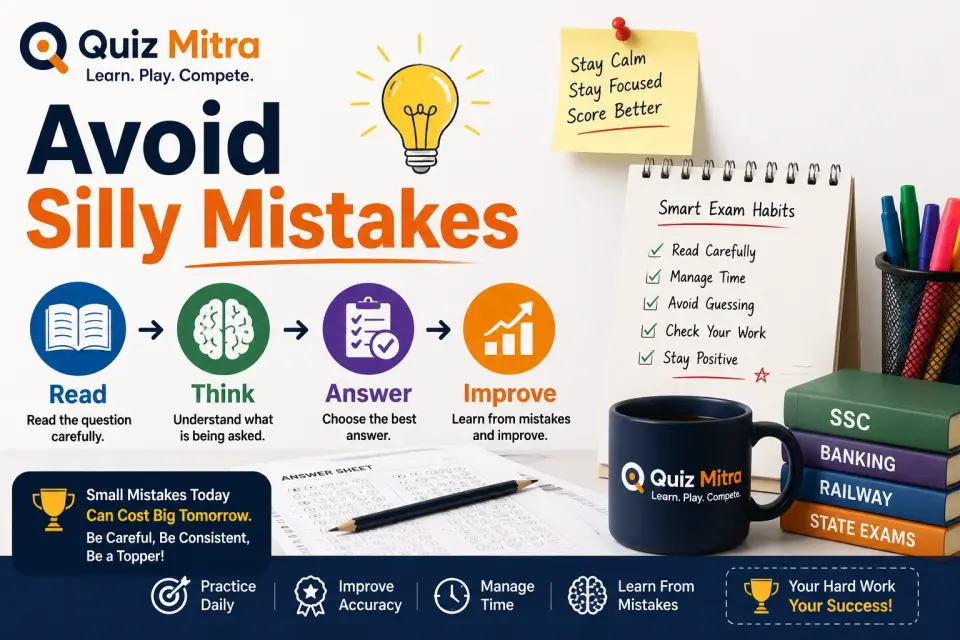
Knowing the correct answer is only one part of performing well in a competitive exam.
Many students lose valuable marks because of avoidable mistakes such as reading a question
incorrectly, rushing through options, making calculation errors or changing a correct
answer without a good reason.
The good news is that accuracy can be improved with practice. By identifying the
reasons behind your mistakes and building a few simple habits, you can reduce
unnecessary errors and make your exam performance more consistent.
Table of Contents
- Understand the Types of Mistakes
- Read the Question Carefully
- Don't Rush Through the Options
- Manage Your Time Wisely
- Double-Check Important Calculations
- Avoid Changing Answers Without a Reason
- Maintain a Mistake Log
- Practise Accuracy With Quizzes
- Use Mock Tests to Test Your Strategy
- Turn Mistakes Into Better Scores
Understand the Types of Mistakes
Before trying to reduce mistakes, understand why they happen.
Most mistakes can be grouped into a few common categories:
Identifying the category is important because each problem requires a different solution.
Most mistakes can be grouped into a few common categories:
- Reading mistakes: You misunderstood what the question was asking.
- Calculation mistakes: You knew the method but made an arithmetic error.
- Knowledge gaps: You didn't know or remember the required information.
- Time-pressure mistakes: You rushed because you were running out of time.
- Careless mistakes: You selected an incorrect option despite knowing the concept.
Identifying the category is important because each problem requires a different solution.
Every mistake is useful if you understand why it happened.
Read the Question Carefully
A surprising number of incorrect answers happen because the student answers
the question they expected instead of the question that was actually asked.
Pay particular attention to words such as:
Before selecting an answer, take a moment to understand exactly what the question requires.
This small habit can prevent many avoidable errors.
Pay particular attention to words such as:
- Not
- Except
- Incorrect
- Correct
- Most appropriate
- Only
Before selecting an answer, take a moment to understand exactly what the question requires.
This small habit can prevent many avoidable errors.
Don't Rush Through the Options
Sometimes students see an option that looks correct and immediately select it.
But competitive exams often include options that are deliberately similar.
If the question is not completely obvious, quickly compare the available options before making your final decision.
Eliminate clearly incorrect choices first. Then compare the remaining options with the exact wording of the question.
This approach can improve both accuracy and confidence.
But competitive exams often include options that are deliberately similar.
If the question is not completely obvious, quickly compare the available options before making your final decision.
Eliminate clearly incorrect choices first. Then compare the remaining options with the exact wording of the question.
This approach can improve both accuracy and confidence.
Manage Your Time Wisely
Time pressure is one of the biggest causes of careless mistakes.
If you spend too long on one difficult question, you may have to rush through several easier questions later.
A better strategy is to divide questions into categories:
Regular mock tests can help you practise this decision-making process under realistic time pressure.
If you spend too long on one difficult question, you may have to rush through several easier questions later.
A better strategy is to divide questions into categories:
- Easy: Solve immediately.
- Moderate: Solve if you can reach the answer efficiently.
- Difficult: Skip temporarily and return later if time allows.
Regular mock tests can help you practise this decision-making process under realistic time pressure.
Double-Check Important Calculations
In quantitative sections, a small calculation error can turn a correct approach
into a wrong answer.
You don't need to recheck every calculation multiple times. Instead, develop the habit of quickly checking important steps when you have enough time.
Pay attention to:
Practising timed questions regularly can help you become faster without sacrificing accuracy.
You don't need to recheck every calculation multiple times. Instead, develop the habit of quickly checking important steps when you have enough time.
Pay attention to:
- Signs such as + and −
- Decimal points
- Units
- Percentages
- Final calculations
Practising timed questions regularly can help you become faster without sacrificing accuracy.
Avoid Changing Answers Without a Reason
Sometimes students select the correct answer and then change it simply because
they become uncertain.
Changing an answer is reasonable when you notice a genuine mistake or remember information that clearly changes your conclusion.
But changing an answer only because you feel nervous can create unnecessary errors.
Trust your preparation, carefully review the question and change your answer only when you have a clear reason.
Changing an answer is reasonable when you notice a genuine mistake or remember information that clearly changes your conclusion.
But changing an answer only because you feel nervous can create unnecessary errors.
Trust your preparation, carefully review the question and change your answer only when you have a clear reason.
Maintain a Mistake Log
One of the simplest ways to improve accuracy is to keep track of your mistakes.
After a quiz or mock test, write down:
Review this list regularly.
If you notice the same mistake repeatedly, give that particular issue extra attention during your next study session.
After a quiz or mock test, write down:
- The question you got wrong
- Your selected answer
- The correct answer
- Why you made the mistake
- What you should remember next time
Review this list regularly.
If you notice the same mistake repeatedly, give that particular issue extra attention during your next study session.
Practise Accuracy With Quizzes
Accuracy improves through deliberate practice.
Instead of focusing only on how many questions you can answer, pay attention to how many you answer correctly.
Use Quiz Mitra quizzes to practise different subjects and question types.
After each quiz, don't just look at your score. Review the questions you answered incorrectly and identify the reason for each mistake.
Over time, this creates a useful cycle:
Practice → Analyse → Correct → Practise Again
Instead of focusing only on how many questions you can answer, pay attention to how many you answer correctly.
Use Quiz Mitra quizzes to practise different subjects and question types.
After each quiz, don't just look at your score. Review the questions you answered incorrectly and identify the reason for each mistake.
Over time, this creates a useful cycle:
Practice → Analyse → Correct → Practise Again
Use Mock Tests to Test Your Strategy
Topic-wise quizzes are excellent for focused practice, but you also need to know
whether your accuracy remains strong when multiple subjects are combined.
That's where full-length mock tests become useful.
After every mock test, compare:
This gives you a clearer picture of whether your problem is knowledge, speed, decision-making or accuracy.
That's where full-length mock tests become useful.
After every mock test, compare:
- Total questions attempted
- Correct answers
- Incorrect answers
- Questions left unanswered
- Time spent
- Topics responsible for most mistakes
This gives you a clearer picture of whether your problem is knowledge, speed, decision-making or accuracy.
Don't Ignore Current Affairs Practice
For exams where Current Affairs is important, regular revision can help you
avoid memory-based mistakes.
Instead of trying to memorise everything at once, use short practice sessions throughout the week.
Try the Daily Current Affairs quiz to test your recall and identify facts that need another revision.
Instead of trying to memorise everything at once, use short practice sessions throughout the week.
Try the Daily Current Affairs quiz to test your recall and identify facts that need another revision.
Turn Mistakes Into Better Scores
Silly mistakes are frustrating, but they are also one of the easiest areas
to work on once you understand their causes.
Read questions carefully, manage your time, practise under pressure and maintain a record of repeated mistakes.
Most importantly, don't judge your preparation only by your score.
A score tells you how you performed today. Your mistakes tell you what you need to improve tomorrow.
Use Quiz Mitra for regular practice, solve Previous Year Questions, attempt mock tests and keep improving your accuracy one question at a time.
Learn. Practise. Analyse. Improve.
Quiz Mitra — Learn. Play. Compete.
Read questions carefully, manage your time, practise under pressure and maintain a record of repeated mistakes.
Most importantly, don't judge your preparation only by your score.
A score tells you how you performed today. Your mistakes tell you what you need to improve tomorrow.
Use Quiz Mitra for regular practice, solve Previous Year Questions, attempt mock tests and keep improving your accuracy one question at a time.
Learn. Practise. Analyse. Improve.
Quiz Mitra — Learn. Play. Compete.