
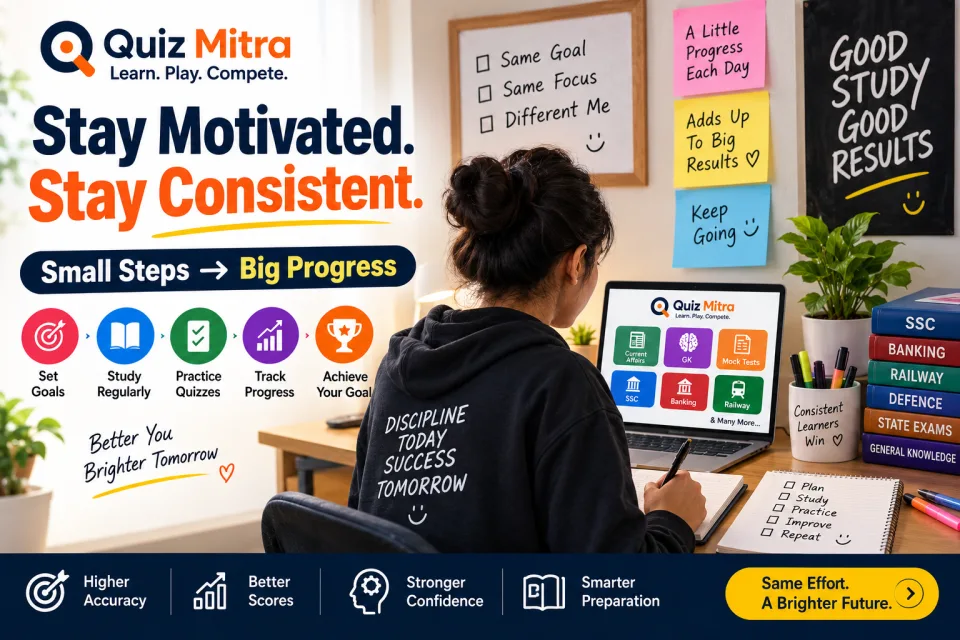
Preparing for a competitive exam is a long journey. At the beginning, motivation is usually
high. You create a study plan, collect your books and imagine yourself achieving your goal.
But after a few weeks or months, maintaining the same energy can become difficult.
The solution isn't to feel motivated every single day. A better approach is to build a
system that helps you continue even when motivation is low. Small goals, regular practice,
progress tracking and realistic expectations can make long-term preparation easier to manage.
Table of Contents
- Why Motivation Drops During Exam Preparation
- Set Small and Achievable Goals
- Build a Routine Instead of Depending on Motivation
- Track Your Progress
- Make Practice More Engaging
- Avoid Comparing Your Preparation With Others
- Learn How to Handle Bad Study Days
- Don't Ignore Rest and Recovery
- Review Your Progress Every Week
- Keep Moving Forward
Why Motivation Drops During Exam Preparation
Long-term preparation can become repetitive.
You study the same subjects, solve hundreds of questions and revise topics that you have already seen before. Progress may also feel slow because the final examination is still months away.
It is normal for motivation to fluctuate during this period.
Instead of expecting yourself to be highly motivated every day, focus on creating habits that make studying easier to continue.
You study the same subjects, solve hundreds of questions and revise topics that you have already seen before. Progress may also feel slow because the final examination is still months away.
It is normal for motivation to fluctuate during this period.
Instead of expecting yourself to be highly motivated every day, focus on creating habits that make studying easier to continue.
Motivation can get you started. Consistency helps you reach the finish line.
Set Small and Achievable Goals
Large goals such as "finish the entire syllabus" can feel overwhelming.
Break them into smaller targets.
Instead of saying:
"I need to complete all of General Knowledge."
Set a smaller target:
"Today I will revise Indian Polity and practise 20 questions."
Small goals give you a clear task and make it easier to recognise progress.
Break them into smaller targets.
Instead of saying:
"I need to complete all of General Knowledge."
Set a smaller target:
"Today I will revise Indian Polity and practise 20 questions."
Small goals give you a clear task and make it easier to recognise progress.
Build a Routine Instead of Depending on Motivation
If you wait until you feel motivated before studying, your preparation can become
inconsistent.
A better strategy is to establish a regular study routine.
For example:
Once a routine becomes familiar, starting your study session can require less mental effort.
A better strategy is to establish a regular study routine.
For example:
- Study at a consistent time each day.
- Keep your study materials ready.
- Set a realistic daily target.
- Include short breaks.
- Finish the day by reviewing your progress.
Once a routine becomes familiar, starting your study session can require less mental effort.
Track Your Progress
Progress can be difficult to notice when you look at the entire preparation journey.
Instead, track smaller improvements.
You could record:
Your score doesn't have to improve dramatically every day. Even a small improvement over several weeks can become meaningful.
Instead, track smaller improvements.
You could record:
- Number of quizzes completed
- Quiz accuracy
- Mock test scores
- Topics completed
- Previous mistakes corrected
- Current Affairs sessions completed
Your score doesn't have to improve dramatically every day. Even a small improvement over several weeks can become meaningful.
Make Practice More Engaging
Studying only through textbooks can sometimes become repetitive.
Add different forms of practice to your routine.
You can combine:
On Quiz Mitra, you can use quizzes as a quick way to test your knowledge instead of spending every study session only reading notes.
Features such as XP, rewards and competitive elements can also make regular practice feel more interactive.
Add different forms of practice to your routine.
You can combine:
- Topic-wise quizzes
- Previous Year Questions
- Current Affairs quizzes
- Mock tests
- Revision sessions
- Timed practice
On Quiz Mitra, you can use quizzes as a quick way to test your knowledge instead of spending every study session only reading notes.
Features such as XP, rewards and competitive elements can also make regular practice feel more interactive.
Avoid Comparing Your Preparation With Others
Everyone has a different starting point, schedule and learning speed.
Someone else may be completing more chapters than you, while you may be improving your accuracy or understanding difficult concepts more deeply.
Instead of constantly asking:
"Am I ahead of everyone else?"
Ask:
"Am I better prepared than I was last month?"
Comparing your current performance with your own previous performance can provide a much more useful measure of progress.
Someone else may be completing more chapters than you, while you may be improving your accuracy or understanding difficult concepts more deeply.
Instead of constantly asking:
"Am I ahead of everyone else?"
Ask:
"Am I better prepared than I was last month?"
Comparing your current performance with your own previous performance can provide a much more useful measure of progress.
Learn How to Handle Bad Study Days
Not every day will be productive.
You may feel tired, distracted or simply unable to concentrate.
One unproductive day doesn't destroy your preparation.
If you cannot complete your normal study target, reduce it.
For example:
The goal on difficult days is simply to avoid completely disconnecting from your preparation.
You may feel tired, distracted or simply unable to concentrate.
One unproductive day doesn't destroy your preparation.
If you cannot complete your normal study target, reduce it.
For example:
- Read one short topic.
- Take a 10-question quiz.
- Review five previous mistakes.
- Revise a small Current Affairs section.
The goal on difficult days is simply to avoid completely disconnecting from your preparation.
Don't Ignore Rest and Recovery
Studying continuously without enough rest can eventually reduce your concentration
and make preparation feel exhausting.
Make room for:
Rest is not necessarily wasted study time. It can help you return to your preparation with better focus.
Make room for:
- Proper sleep
- Short breaks during study sessions
- Physical activity
- Time away from study materials
- Relaxation and hobbies
Rest is not necessarily wasted study time. It can help you return to your preparation with better focus.
Review Your Progress Every Week
Spend a few minutes at the end of each week reviewing what you accomplished.
Ask yourself:
Use mock tests and quiz practice as measurable checkpoints.
A weekly review turns preparation into a process that you can continuously adjust.
Ask yourself:
- What topics did I complete?
- Which subjects improved?
- Where am I still making mistakes?
- How many quizzes did I practise?
- Did my mock test performance improve?
- What should I change next week?
Use mock tests and quiz practice as measurable checkpoints.
A weekly review turns preparation into a process that you can continuously adjust.
A Simple Daily Motivation Routine
You don't need a complicated system.
Try this simple routine:
You can also add Daily Current Affairs practice to maintain regular awareness of important events.
Try this simple routine:
- Choose one realistic study goal.
- Study the topic without distractions.
- Take a short quiz to test yourself.
- Review your mistakes.
- Record your progress.
- Stop when your planned session is complete and allow yourself to rest.
You can also add Daily Current Affairs practice to maintain regular awareness of important events.
Keep Moving Forward
Competitive exam preparation is a marathon rather than a single study session.
You will have highly productive days and days when very little seems to go according to plan.
Don't expect constant motivation. Instead, build a routine that allows you to continue even when motivation naturally goes up and down.
Set small goals, track your progress, practise regularly and learn from your mistakes.
Use Quiz Mitra for regular quiz practice, Previous Year Questions for exam-focused practice and mock tests to measure your preparation.
Most importantly, don't worry about being perfect every day.
Just keep learning, keep practising and keep moving forward.
Quiz Mitra — Learn. Play. Compete.
You will have highly productive days and days when very little seems to go according to plan.
Don't expect constant motivation. Instead, build a routine that allows you to continue even when motivation naturally goes up and down.
Set small goals, track your progress, practise regularly and learn from your mistakes.
Use Quiz Mitra for regular quiz practice, Previous Year Questions for exam-focused practice and mock tests to measure your preparation.
Most importantly, don't worry about being perfect every day.
Just keep learning, keep practising and keep moving forward.
Quiz Mitra — Learn. Play. Compete.