Finding information online has changed dramatically. For years, Google Search has been the starting point for discovering websites, reading articles, comparing products, and answering questions. Now, AI-powered search tools are changing how people research topics by combining information from sources and presenting it in conversational answers.
But which approach is better? In 2027, should you use AI search tools, traditional Google Search, or both?
The answer depends on what you are trying to find. AI search can be useful when you need a summarized explanation or help exploring a complicated subject. Google Search remains valuable when you want to discover original websites, locate specific pages, compare sources, or find official information.
In this guide, we compare AI search vs Google in 2027, explain the advantages and limitations of each, and share practical ways to find reliable information faster.
Table of Contents
What Is AI Search?
AI search uses artificial intelligence to help users discover, understand, and summarize information. Instead of showing only a list of links, an AI-powered search experience may generate a direct answer, combine information from multiple sources, suggest follow-up questions, or help users investigate a topic through a conversation.
Some AI search products retrieve information from the web and provide source links. Others primarily use their underlying language models or combine web access with additional tools. Their capabilities vary, so it is important to check whether a particular answer is based on current web sources.
For example, imagine you want to understand the differences between several project management tools. Traditional search can help you find official product pages, reviews, and comparisons. An AI search tool may help summarize those sources into a comparison and identify factors you should consider.
AI search is not necessarily separate from traditional search. Many modern search experiences combine conventional web results with AI-generated summaries or conversational features.
AI Search vs Google: Key Differences
Google Search is a search engine that helps users discover webpages and other content. AI search tools focus more heavily on interpreting questions, synthesizing information, and supporting follow-up research. These categories overlap as search products add AI features.
| Feature | Google Search | AI Search Tools |
|---|---|---|
| Results format | Links, snippets, and other search features | Often conversational answers with summaries and citations |
| Research style | Visit and compare individual sources | May synthesize information across sources |
| Follow-up questions | Usually require another query or search refinement | Often support conversational follow-ups |
| Finding official pages | Useful for discovering specific websites and documents | Can help locate them when web search and citations are supported |
| Current information | Depends on indexing and available results | Depends on web access, source freshness, and retrieval quality |
| Source verification | Lets users inspect individual pages directly | Requires checking citations and confirming claims against sources |
| Complex explanations | May require reading several articles | Can provide a structured explanation in one response |
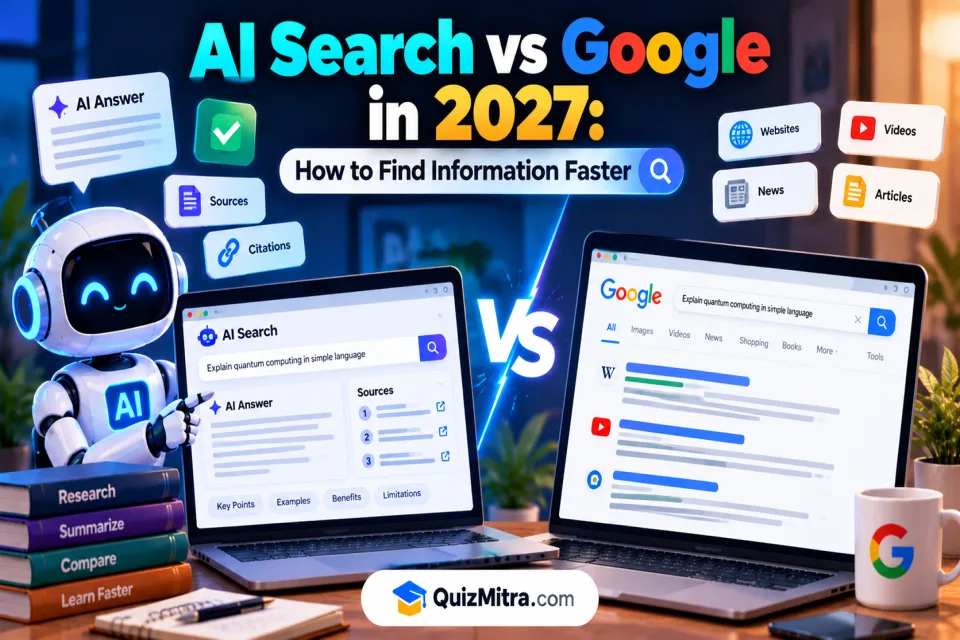
Neither approach wins every time. Google is useful for discovering original sources, while AI search can reduce the effort needed to understand information. The most effective approach often combines the two.
AI Search Tools to Explore in 2027
These tools are worth exploring for AI-assisted research and search. Their features, availability, and pricing may change before or during 2027, so check each official website for current details.
1. Perplexity
Perplexity is an AI-powered answer and research tool designed to help users explore questions and discover supporting sources. It can be useful when you want an overview of a topic without manually opening every result first.
Useful for: Topic research, source discovery, comparisons, and research summaries.
Official website: Perplexity
2. ChatGPT Search
ChatGPT can support web-assisted research where search features are available. Users can ask questions in natural language, request explanations, and follow up to explore a topic in greater detail.
Useful for: Research assistance, explanations, brainstorming, and summarizing information.
Official website: ChatGPT
3. Google Search and AI Features
Google continues to combine traditional search with AI-powered experiences in supported markets and products. This approach can help users receive summaries while retaining access to conventional search results and source links.
Useful for: General web discovery, local information, official websites, and searches that benefit from both summaries and links.
Official website: Google Search
4. Google Gemini
Gemini is Google's AI assistant. Depending on the features available, it can help explain topics, summarize information, brainstorm ideas, and assist with research. Check whether the experience you use has access to current web information before relying on time-sensitive answers.
Useful for: Explanations, research assistance, brainstorming, and supported Google-related workflows.
Official website: Google Gemini
5. Microsoft Copilot
Microsoft Copilot provides AI assistance for questions, research, and productivity tasks. Its web-related capabilities can help users explore information and prepare summaries, depending on the version and features available.
Useful for: General research, summarization, and workflows involving supported Microsoft products.
Official website: Microsoft Copilot
When Google Search Is Better
Traditional search is particularly useful when you need to reach a specific source or inspect the original information yourself.
Finding Official Information
If you need a government notification, official company policy, product documentation, university admission page, or original research paper, finding the primary source is often more important than receiving a summary.
Discovering Websites and Businesses
Search results can help you discover websites, local businesses, product pages, maps, and other specialized information. You can compare the results directly and decide which sources deserve your attention.
Checking Multiple Perspectives
Google can help you find different publishers and viewpoints. You still need to evaluate source quality, publication dates, evidence, and possible conflicts of interest.
Finding an Exact Page
When you already know a website or document title, a focused search can be a quick way to locate it. Search operators and exact-phrase queries can make the process more precise.
When AI Search Is Better
AI search can be especially helpful when the challenge is not simply finding a page but understanding a topic or combining information.
Understanding Complicated Topics
You can ask an AI search tool to explain a concept in simple language, compare approaches, or organize an unfamiliar subject into smaller parts. This can be helpful for students, professionals, and people learning a new skill.
Summarizing Multiple Sources
Some tools can synthesize information from several sources into a single overview. This can save time during early research, but you should still open important citations and verify the underlying claims.
Asking Follow-Up Questions
Conversational search allows you to refine a question without starting over each time. You might first ask for a comparison, then request a cost breakdown, limitations, or recommendations for a particular use case.
Creating a Structured Research Plan
AI tools can turn a broad question into a research outline, identify subtopics to investigate, and suggest what evidence to look for. This is useful when beginning a report, project, or study session.
Remember: A fluent AI-generated answer is not automatically a correct answer. For important decisions, verify the original source rather than relying only on the summary.
Accuracy, Sources, and Trust
Accuracy is one of the most important considerations when comparing AI search with traditional search. Both can lead you to useful information, but neither guarantees that every result is correct or complete.
Traditional search can surface outdated pages, misleading websites, advertisements, or content that does not fully answer your question. AI search can summarize unreliable information, overlook important context, or generate a claim that its citations do not actually support.
Use these checks before relying on a result:
- Check the original source: Open the cited page instead of trusting a summary alone.
- Verify the date: Make sure the information is recent enough for your question.
- Look for primary evidence: Prefer official documents, original studies, and first-party announcements when appropriate.
- Cross-check important claims: Compare independent, credible sources.
- Check the citation carefully: Confirm that the source actually supports the specific claim.
- Be careful with sensitive topics: For medical, legal, financial, or safety-related decisions, consult authoritative sources and qualified professionals where appropriate.
How to Find Information Faster in 2027
You do not need to choose just one search method. A simple workflow can combine the speed of AI-assisted summaries with the reliability checks of original sources.
Step 1: Define Your Question
Be specific about what you want to know. Instead of searching for "AI tools," try "Which AI tools can summarize long PDF documents, and what are their limitations?"
Step 2: Use AI for an Initial Overview
Ask an AI search tool to explain the topic, identify the main options, and provide sources. Request that it distinguish verified facts from uncertain information.
Step 3: Use Google to Find Primary Sources
Search for official documentation, original announcements, published research, or the exact webpage behind an important claim. This helps you check details that a summary may leave out.
Step 4: Compare Evidence, Not Just Answers
If two tools provide different answers, examine the underlying sources. Look at the publication date, methodology, context, and evidence before deciding which explanation is more credible.
Step 5: Save the Useful Information
Keep links to important sources and write a short summary of what you learned. For recurring research, maintain a document with source links, dates, key findings, and questions that still need answers.
Example: Researching the Best AI Coding Tools
- Ask an AI search tool to identify coding assistants for your programming language and budget.
- Use Google to find the official product pages and documentation.
- Check which features are available, the current pricing, and any usage limits.
- Look for independent reviews and real-world testing where useful.
- Choose a tool based on your project requirements rather than a generated ranking alone.
The Future of Search in 2027
Search technology is likely to continue evolving, but the exact features and market changes in 2027 cannot be guaranteed. Several developments are worth watching.
1. More Conversational Search
Search experiences may make it easier to refine questions, explore related topics, and continue research through natural conversation.
2. More AI Summaries With Source Links
Search products may continue experimenting with summaries alongside conventional results. Clear citations and easy access to original sources will remain important for users who need to verify information.
3. More Multimodal Search
Searching with images, voice, and other kinds of input may become increasingly useful. This can help users identify objects, understand visual information, and ask questions about content beyond plain text.
4. Greater Focus on Personalization
Search tools may offer more ways to tailor results to a user's goals and preferences. This creates convenience but also makes privacy, transparency, and control over personal data important considerations.
5. A Blended Search Experience
The distinction between traditional search and AI search may become less obvious as search engines integrate AI features and AI assistants gain stronger retrieval capabilities. Users will still benefit from knowing how to find and evaluate original sources.
Final Verdict: AI Search or Google?
AI search and Google Search solve overlapping but different problems. AI search is useful for explanations, summaries, comparisons, and conversational research. Google Search is valuable for discovering original webpages, finding official information, and inspecting different sources directly.
For many research tasks, the most effective method is to use AI for an initial overview and Google to verify important claims. This approach can reduce unnecessary searching without sacrificing the ability to check facts.
If you want to explore more AI-powered research and productivity solutions, visit the QuizMitra AI Tools Directory. You can also explore the AI Prompt Library to find prompts that help you ask better questions and get more useful responses.
Frequently Asked Questions
Is AI search better than Google in 2027?
Neither is better for every task. AI search can be useful for explanations and summaries, while Google Search is helpful for finding original webpages and official information. Combining both is often effective.
What is the difference between AI search and traditional search?
Traditional search primarily helps users discover and visit relevant webpages. AI search can interpret a question and generate a summarized answer, sometimes using information retrieved from multiple sources.
Which AI search tools should I try?
You can explore Perplexity, ChatGPT with search features, Google Gemini, and Microsoft Copilot. Compare their available capabilities, source links, privacy policies, and pricing before choosing.
Can AI search provide incorrect information?
Yes. AI systems may produce inaccurate summaries, miss context, or cite sources that do not support every claim. Check important information against reliable original sources.
Is Google Search still useful with AI tools available?
Yes. Google remains useful for finding websites, official documents, local information, product pages, and multiple perspectives. AI features can complement these traditional search capabilities.
How can I find information faster online?
Start with a specific question, use AI to organize the topic, locate primary sources through search, and verify important claims. Save useful links so you do not need to repeat the same research.
Explore more AI resources:
Quiz Mitra — Learn. Play. Compete.