
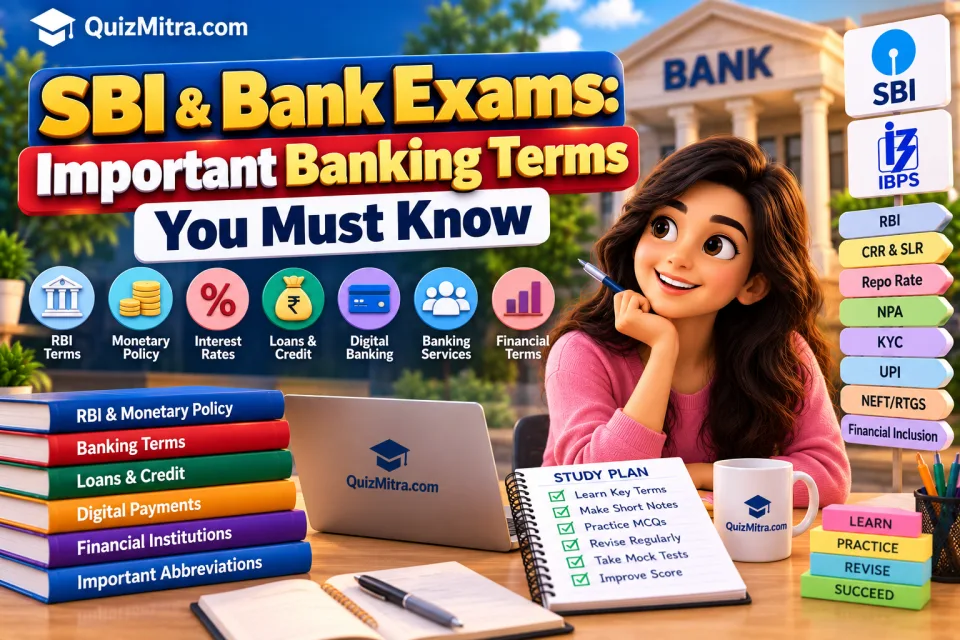
If you are preparing for SBI, IBPS or other banking examinations, understanding important banking terminology is an essential part of Banking Awareness preparation.
Questions can test your understanding of terms related to the RBI, monetary policy, banking operations, digital payments, loans, deposits, financial inclusion and the economy.
This guide explains important banking terms in simple language so that you can revise them quickly before your examination.
Table of Contents
- Why Banking Terms Are Important
- Important RBI and Monetary Policy Terms
- Important Banking Terms
- Loan and Credit Terms
- Digital Banking Terms
- Payment System Terms
- Customer and Account Terms
- Important Financial Terms
- How to Memorise Banking Terms
- Banking Terms Revision Strategy
- Frequently Asked Questions
Why Are Banking Terms Important for SBI & Bank Exams?
Banking terminology forms the foundation of Banking Awareness. Understanding basic terms can make questions related to RBI, monetary policy, loans, digital payments and financial institutions easier to understand.
Instead of memorising hundreds of definitions at once, divide the terms into small groups and revise them regularly.
Important RBI & Monetary Policy Terms
1. RBI
RBI stands for Reserve Bank of India. It is India's central bank and performs monetary, regulatory, supervisory, currency-management and payment-system functions within its statutory responsibilities.
2. Repo Rate
The Repo Rate is a policy rate associated with liquidity provided by RBI under the applicable monetary-policy framework.
3. Reverse Repo Rate
Reverse Repo Rate refers to the rate associated with certain RBI operations for absorbing liquidity from the banking system under the applicable framework.
4. CRR
CRR stands for Cash Reserve Ratio. It refers to the prescribed cash reserve that banks are required to maintain with the RBI under applicable regulations.
5. SLR
SLR stands for Statutory Liquidity Ratio. It refers to the prescribed portion of specified liabilities that banks must maintain in specified liquid assets under applicable regulations.
6. Bank Rate
Bank Rate is a policy rate published by RBI and is part of the monetary-policy framework.
7. Monetary Policy
Monetary Policy refers to measures through which a central bank influences monetary and financial conditions in the economy.
8. Monetary Policy Committee
The Monetary Policy Committee (MPC) is the body responsible for determining the policy repo rate under India's monetary-policy framework.
9. Open Market Operations
Open Market Operations (OMO) involve the purchase or sale of government securities by the central bank as part of liquidity and monetary management.
Important Banking Terms
10. Commercial Bank
A commercial bank provides services such as accepting deposits, providing loans and facilitating payments.
11. Deposit
A deposit is money placed by a customer with a bank under the terms of the relevant account.
12. Savings Account
A savings account is a deposit account generally used by individuals for saving money and accessing banking services.
13. Current Account
A current account is generally designed for frequent transactions and is commonly used by businesses and organisations.
14. Fixed Deposit
A Fixed Deposit (FD) is a deposit placed with a bank for a specified period under agreed terms.
15. Recurring Deposit
A Recurring Deposit (RD) allows customers to make regular deposits according to the terms of the account for a specified period.
Important Loan & Credit Terms
16. Loan
A loan is an amount provided by a lender to a borrower under agreed repayment terms.
17. Principal
Principal is the original amount of money borrowed or invested before applicable interest or returns.
18. Interest
Interest is the amount charged on borrowed money or earned on certain deposits and investments according to the applicable terms.
19. EMI
EMI stands for Equated Monthly Instalment. It is a periodic payment made by a borrower towards repayment of a loan, generally consisting of principal and interest components.
20. NPA
NPA stands for Non-Performing Asset. It refers to a loan or advance classified as non-performing according to applicable regulatory norms.
21. Secured Loan
A secured loan is backed by collateral or security according to the lending agreement.
22. Unsecured Loan
An unsecured loan is not backed by specific collateral and is provided based on the lender's eligibility and risk assessment.
23. Credit Score
A credit score is a numerical representation generated using credit information according to the methodology of the relevant credit information company.
Important Customer & Banking Terms
24. KYC
KYC stands for Know Your Customer. It refers to procedures used by regulated entities to establish and verify customer identity and meet applicable requirements.
25. AML
AML stands for Anti-Money Laundering. It refers to measures designed to prevent and detect the use of the financial system for money laundering.
26. Financial Inclusion
Financial Inclusion refers to improving access to useful and affordable financial services for individuals and businesses.
27. Financial Literacy
Financial Literacy means having the knowledge and skills needed to understand and use financial products and services effectively.
Important Digital Banking Terms
28. UPI
UPI stands for Unified Payments Interface. It enables instant digital payments through participating banks and supported applications.
29. Internet Banking
Internet Banking allows customers to access banking services through an online banking platform.
30. Mobile Banking
Mobile Banking enables customers to access banking services through mobile devices and supported applications.
31. Digital Payment
A digital payment is a payment made electronically without the physical exchange of cash.
32. QR Code Payment
QR Code Payment allows users to make digital payments by scanning a supported QR code through an appropriate payment application.
Important Payment System Terms
33. NEFT
NEFT stands for National Electronic Funds Transfer. It is an electronic funds-transfer system.
34. RTGS
RTGS stands for Real Time Gross Settlement.
35. IMPS
IMPS stands for Immediate Payment Service.
36. IFSC
IFSC stands for Indian Financial System Code. It is used to identify bank branches for electronic financial transactions.
37. MICR
MICR stands for Magnetic Ink Character Recognition. It is associated with the processing and identification of certain banking instruments such as cheques.
38. Cheque
A cheque is a written instrument that directs a bank to make a payment according to the specified instructions and applicable rules.
Important Financial Terms
39. Inflation
Inflation refers to a sustained increase in the general price level of goods and services over time.
40. Liquidity
Liquidity refers to the availability of funds or the ease with which an asset can be converted into cash.
41. GDP
GDP stands for Gross Domestic Product. It measures the value of final goods and services produced within an economy during a specified period.
42. Fiscal Policy
Fiscal Policy refers to government decisions concerning taxation, expenditure and borrowing.
43. Monetary Policy
Monetary Policy concerns the management of monetary and financial conditions by the central bank within its policy framework.
44. Base Rate
Base Rate is a historical benchmark lending-rate concept used by banks under the applicable regulatory framework.
45. MCLR
MCLR stands for Marginal Cost of Funds based Lending Rate. It is a benchmark lending-rate framework introduced for determining certain lending rates.
Banking Terms Quick Revision Table
| Term | Full Form / Meaning |
|---|---|
| RBI | Reserve Bank of India |
| CRR | Cash Reserve Ratio |
| SLR | Statutory Liquidity Ratio |
| UPI | Unified Payments Interface |
| NEFT | National Electronic Funds Transfer |
| RTGS | Real Time Gross Settlement |
| IMPS | Immediate Payment Service |
| KYC | Know Your Customer |
| NPA | Non-Performing Asset |
| EMI | Equated Monthly Instalment |
| IFSC | Indian Financial System Code |
| MICR | Magnetic Ink Character Recognition |
| AML | Anti-Money Laundering |
| GDP | Gross Domestic Product |
How to Memorise Banking Terms
Trying to memorise all banking terms in one sitting can make revision difficult. Divide them into categories.
- RBI and monetary policy terms
- Loan and credit terms
- Deposit-related terms
- Digital banking terms
- Payment-system terms
- Financial and economic terms
Create short notes and revise the same terms repeatedly. After learning them, test yourself using MCQs.
7-Day Banking Terms Revision Plan
| Day | Topics |
|---|---|
| Day 1 | RBI & Monetary Policy |
| Day 2 | Deposits & Accounts |
| Day 3 | Loans & Credit |
| Day 4 | Digital Banking |
| Day 5 | Payment Systems |
| Day 6 | Financial & Economic Terms |
| Day 7 | Full Revision + Banking MCQs |
Practice Banking Questions on QuizMitra
Learning definitions is only the first step. Regular MCQ practice helps you check whether you can correctly apply and recall the concepts.
After studying these banking terms, try topic-wise Banking quizzes and review the questions you answer incorrectly.
Practice Banking Quizzes on QuizMitra →
Learn • Practice • Analyse • Improve
Common Mistakes to Avoid
- Memorising abbreviations without understanding them.
- Confusing CRR and SLR.
- Mixing up NEFT, RTGS and IMPS.
- Ignoring loan-related terminology.
- Not revising banking terms regularly.
- Reading definitions without solving questions.
Frequently Asked Questions
Which banking terms should I learn for SBI exams?
Start with RBI, Repo Rate, CRR, SLR, Bank Rate, NPA, KYC, UPI, NEFT, RTGS, IMPS, EMI, IFSC and other basic banking and financial terms.
Are banking terms important for IBPS exams?
Banking terminology is useful for Banking Awareness and General Awareness preparation. Candidates should also follow the current examination syllabus and notification.
What is the best way to learn banking terminology?
Group similar terms together, learn their meanings, make short notes and practise MCQs regularly.
How can I remember banking abbreviations?
Write the abbreviation together with its full form and meaning, then test yourself repeatedly using active recall.
Where can I practise Banking MCQs?
You can practise Banking quizzes on QuizMitra Banking .
Final Words
Banking terms are the building blocks of Banking Awareness preparation. Once you understand the basic terminology, topics such as RBI, monetary policy, loans, digital payments and financial current affairs become easier to follow.
Keep your revision simple: learn a small group of terms, test yourself with MCQs and revisit the terms you forget.
Learn • Practice • Analyse • Improve
QuizMitra — Learn. Play. Compete.